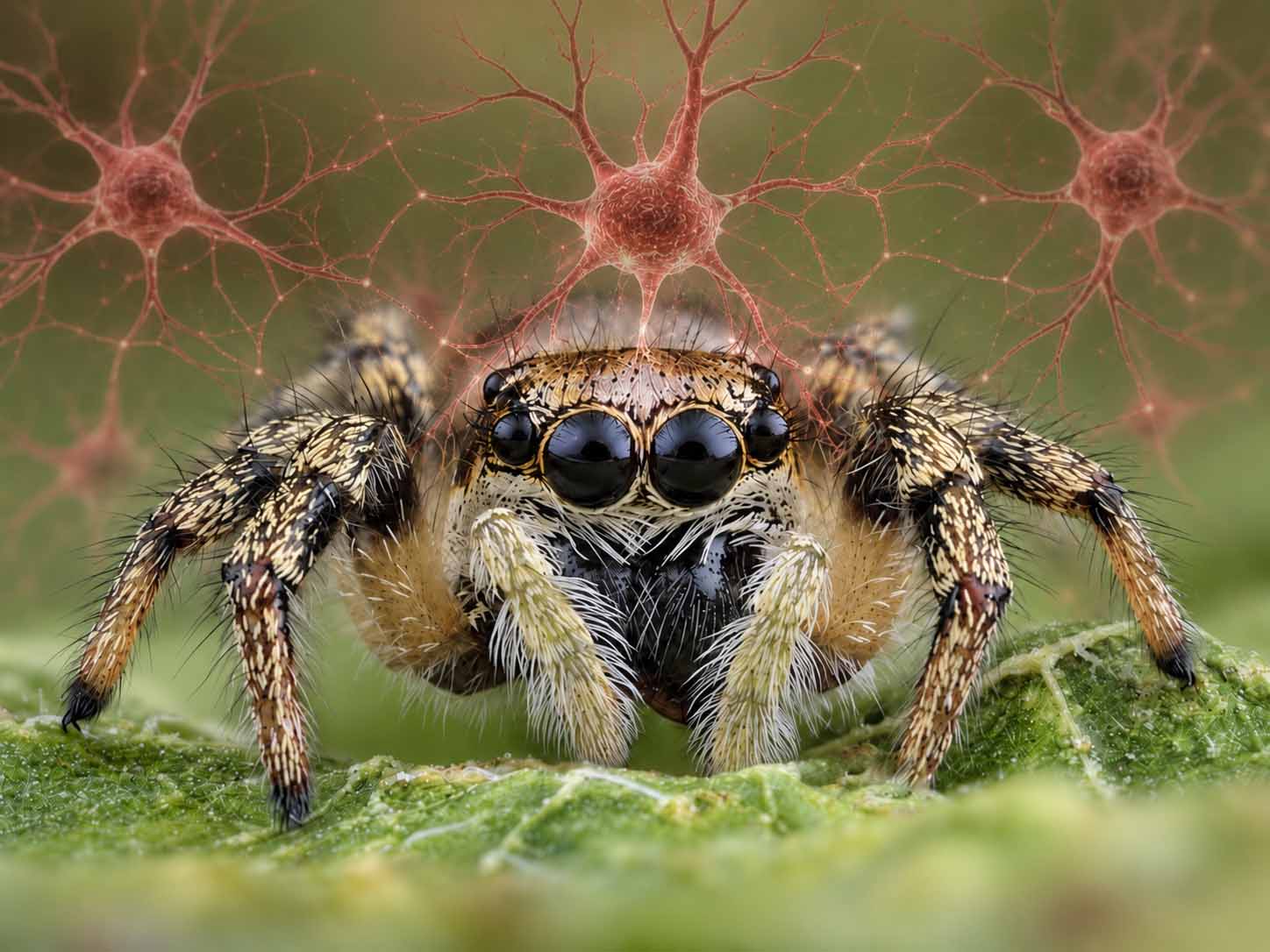


If you watch a jumping spider for a while, you’ll quickly get a strange feeling.
It looks back.
It turns toward us. It tracks movements. It seems to observe something, pause briefly, and then deliberately choose a direction.
Anyone who keeps jumping spiders is probably familiar with exactly these moments.
And that’s why, at some point, an astonishing claim emerges:
Jumping spiders are supposedly as intelligent as a sheep.
That sounds spectacular. Scientifically, however, intelligence cannot be compared on a simple scale between such completely different animals.
So a jumping spider isn’t simply a tiny sheep with eight legs.
But that doesn’t make it any less impressive.
After all, jumping spiders can actually learn to remember things, make decisions, plan detours, distinguish between quantities, and apparently even recognize individual members of their own species.
And all of this takes place in a nervous system that is minuscule compared to the brain of a vertebrate. That is precisely why researchers are now intensively studying the question:
Just how much thinking can actually fit into a jumping spider?
Intelligence is more than just brain size
We humans tend to associate intelligence with large brains.
Humans have large brains. Great apes do as well. Dolphins, elephants, and crows are considered intelligent.
A jumping spider, on the other hand, fits comfortably on a fingertip.
At first glance, the comparison seems absurd.
However, in behavioral research, it is not just the size of a brain that matters. What matters is what an animal can do with its existing nerve cells.
Can it learn from experience?
Can it modify a strategy once it has been learned?
Can it store information?
Can it choose between several options?
Can it find a solution even if the goal isn’t visible at the moment?
It is precisely in tasks like these that jumping spiders become interesting.
They don’t have a small human brain. Instead, their information processing is highly specialized for the things that are important to their survival: vision, hunting, orientation, and quick decision-making. Modern review articles therefore consider jumping spiders to be a particularly interesting model for comparative cognitive research.
Experiment 1: The spider that plans a path before setting off
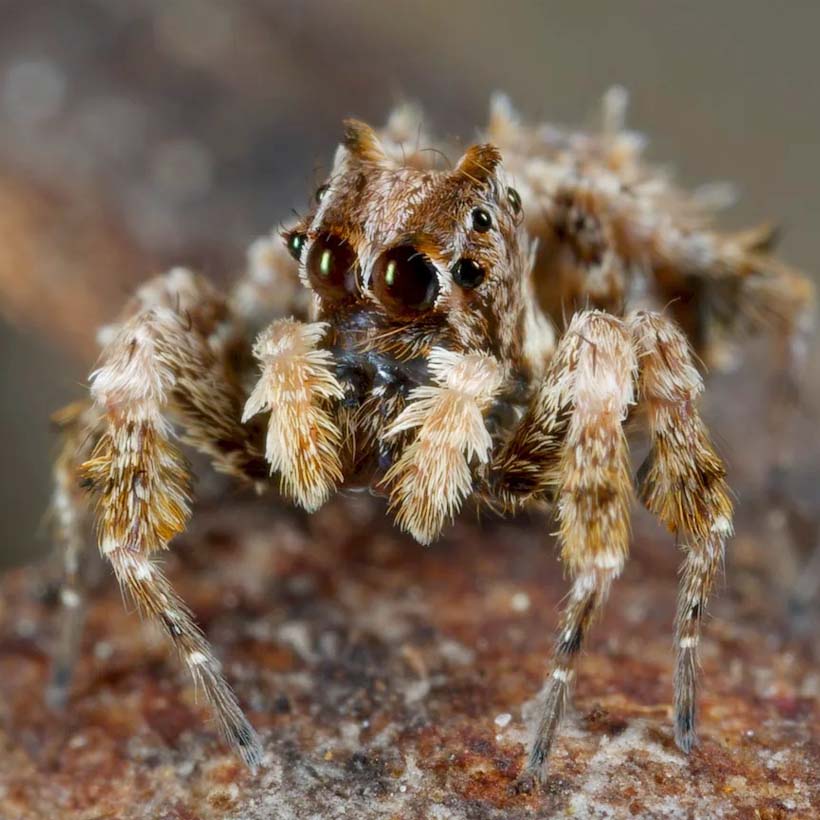
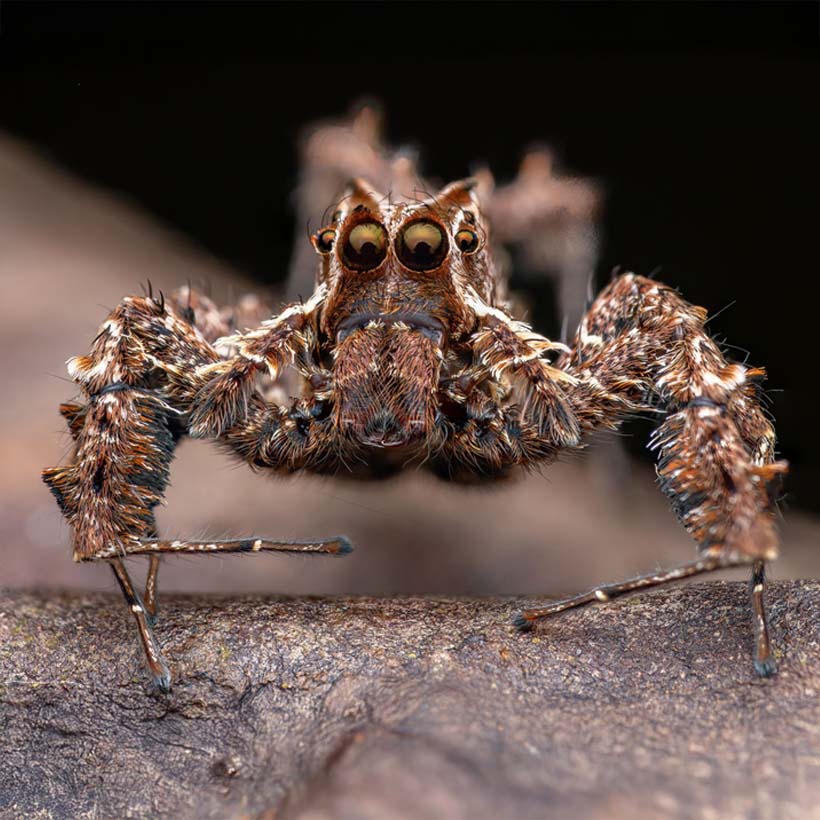
One of the most famous examples comes from jumping spiders of the genus Portia.
Portia is exceptional even among jumping spiders. These animals often hunt other spiders—prey that can also react quickly and, in the worst case, bite back.
Blindly jumping at them would be a pretty poor strategy.
In a classic experiment, a Portia was placed on a raised platform.
From there, it could see two possible paths.
One led over various bars and ramps to a prey spider.
The other led to nowhere.
The key point here:
Once the jumping spider had set off on her path, she could no longer see the destination in some cases.
So she had to get her bearings first and then follow a path, even though the prey had disappeared from her field of vision at times.
Think of it this way, to put it simply:
You’re standing on an observation tower.
Below, you see two forest trails.
The one on the left winds around a hill and leads to your car. The one on the right looks just as good at first, but eventually ends at a fence.
Once you leave the tower, you can no longer see your car.
So you have to decide which path to take before you set off.
This is exactly the kind of problem the spiders solved.
Further studies showed that Portia can even choose routes where she first has to move away from her prey in order to reach it later.
That sounds obvious, but it isn’t.
An animal that were to follow only the current visual stimulus would always have to run toward its prey.
Portia can apparently do something else:
ignore the immediate target, choose an alternative route, and only head back toward it later.
She loses sight of her prey—but keeps searching anyway
It gets even more fascinating outside the lab.
In the wild, too, Portia jumping spiders have been observed taking complicated detours to reach web-building spiders.
In the process, the prey can disappear completely from its field of vision for extended periods.
For example, the jumping spider runs around vegetation, changes its position, and then approaches the web from a more advantageous angle.
This doesn’t automatically mean that a jumping spider thinks in our human sense:
“If I run this way, I’ll be behind her in ten minutes.”
But her behavior suggests that she can store information about a target internally and reuse it later. It is precisely this question of internal representations that has made Portia so interesting to cognitive scientists.
Experiment 2: Can a jumping spider count?
Now it gets even more curious.
Researchers studied Portia africana to see if the spiders can distinguish how many other spiders they see.
To do this, they used a method that can be described, in simple terms, as an “expectation violation.”
For example, a jumping spider would first see a certain number of prey items.
Then its view was briefly interrupted.
When she could see the animals again, their number had changed.
The crucial question was:
Does the spider notice that something is wrong?
And indeed, the animals reacted differently when the expected number suddenly changed.
The pattern was particularly interesting.
The results suggest that Portia can distinguish between one, two, and “more than two.” Changes between larger numbers, such as three and four, however, were not recognized in the same way.
One shouldn’t jump to the conclusion that:
“Jumping spiders can do math.”
That would be an exaggeration.
But apparently, at least a simple form of set representation exists.
Or, to put it more simply:
A jumping spider seems to distinguish between
one spider, two spiders, and several spiders
in its mind.
That’s pretty amazing for an animal of that size.
Experiment 3: They Can Learn—and Change Their Minds
Intelligence isn’t just about learning something.
It gets even more interesting when an animal realizes:
The old rule no longer works.
This is exactly what was investigated in the jumping spider Marpissa muscosa.
The spiders first learned to associate certain colors or positions with a food reward.
For example, you could think of it simply like this:
Yellow = food.
Blue = no food.
The spiders learned this association.
Then the researchers reversed the rule.
Suddenly, the decision that had previously been correct was wrong.
Now the spiders had to, so to speak, overwrite their old experience and learn a new rule.
And that’s exactly what they were able to do.
The spiders were able to learn associations and then reverse them. In doing so, individual spiders even exhibited different strategies: Some relied more on colors, while others relied more on positions.
This is important.
Because completely rigid behavior would work something like this:
“I’ve learned that yellow means food. So I’ll always choose yellow.”
Flexible behavior, on the other hand, means:
“Yellow has worked so far. Now it’s not working anymore. So I’m changing my strategy.”
It is precisely this flexibility that is a key foundation of cognition.
Experiment 4: A jumping spider recognizes something even though it consists only of dots
Jumping spiders are extremely visually oriented animals.
Just how refined this visual processing can be was demonstrated by a particularly unusual experiment.
Researchers presented jumping spiders with so-called point-light displays.
You don’t actually see a real animal.
Imagine a completely black surface on which only a few bright dots appear.
These points are located where, for example, a spider’s joints would be.
When the dots move together, our brain realizes with astonishing speed:
Something alive is moving there.
Even though we don’t see a body at all.
Even jumping spiders can distinguish between such biologically driven movement patterns and random movement.
That doesn’t mean a jumping spider consciously ponders the difference between “alive” and “not alive.”
But its nervous system apparently does more than just analyze:
“Something is moving.”
It also processes:
How is it moving?
That’s a significant difference.
Experiment 5: Jumping spiders recognize prey by its shape
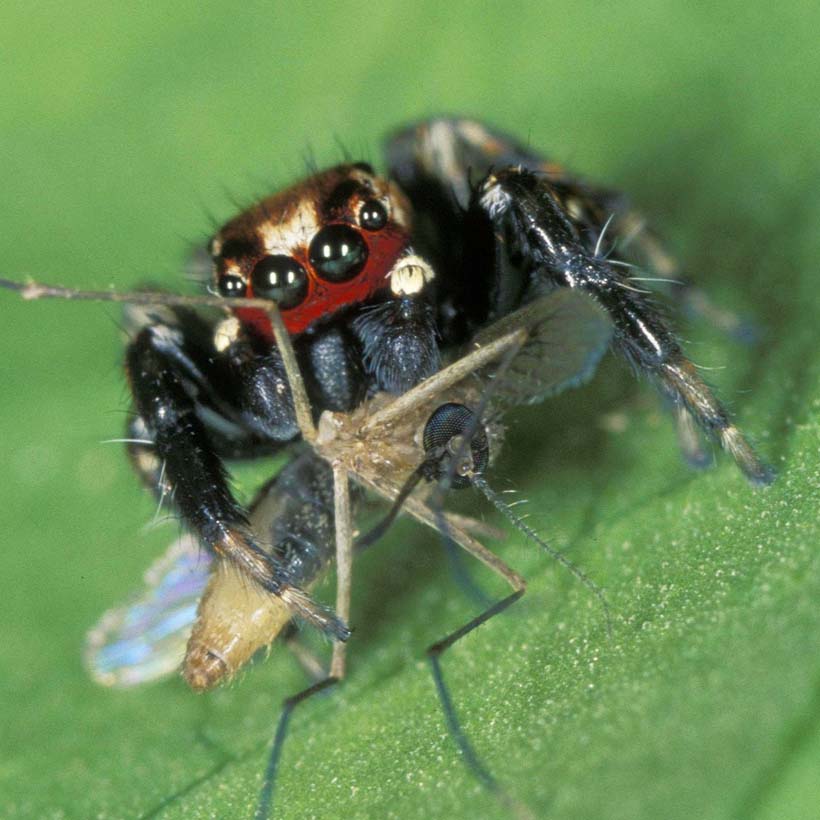
Another jumping spider with impressive abilities is Evarcha culicivora.
This species has an unusual preference: among other things, it hunts blood-filled female mosquitoes.
Researchers wanted to find out which visual characteristics the spider uses to identify its preferred prey.
To do this, they did not show it real mosquitoes.
Instead, they used highly simplified representations—some of which were almost like line drawings.
Despite this simplification, the spiders were able to recognize and categorize relevant features of their preferred prey.
This is roughly comparable to a child recognizing a drawn dog, even though the drawing consists of only a few lines.
Of course, the underlying brain processes are completely different.
But the principle is interesting:
The spider apparently does not necessarily need a perfect photographic image.
Certain characteristic features are sufficient for its nervous system to classify something into a category.
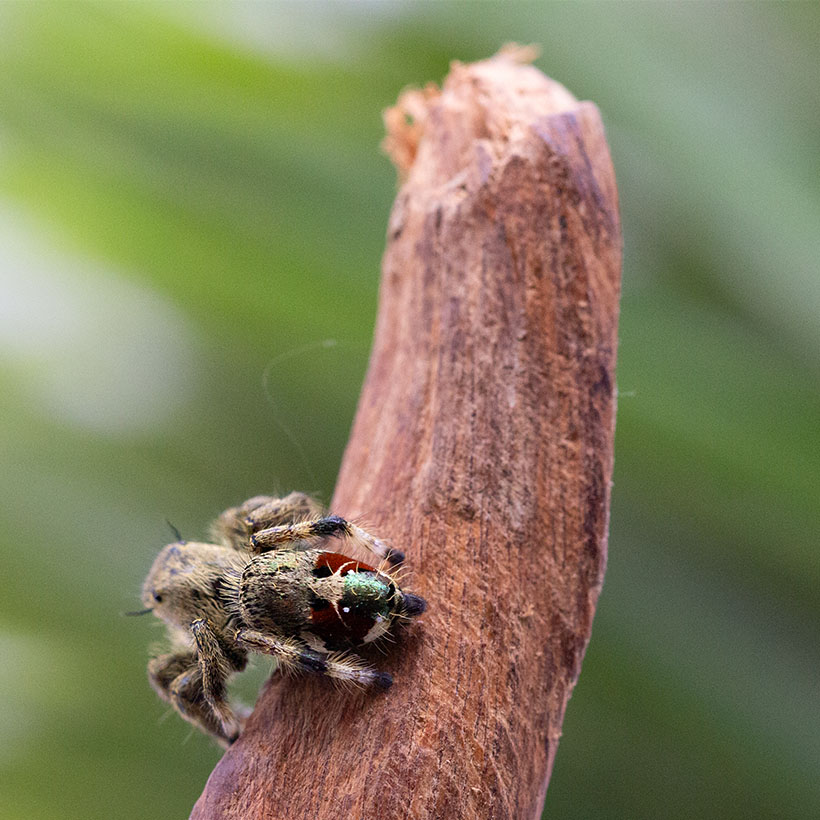
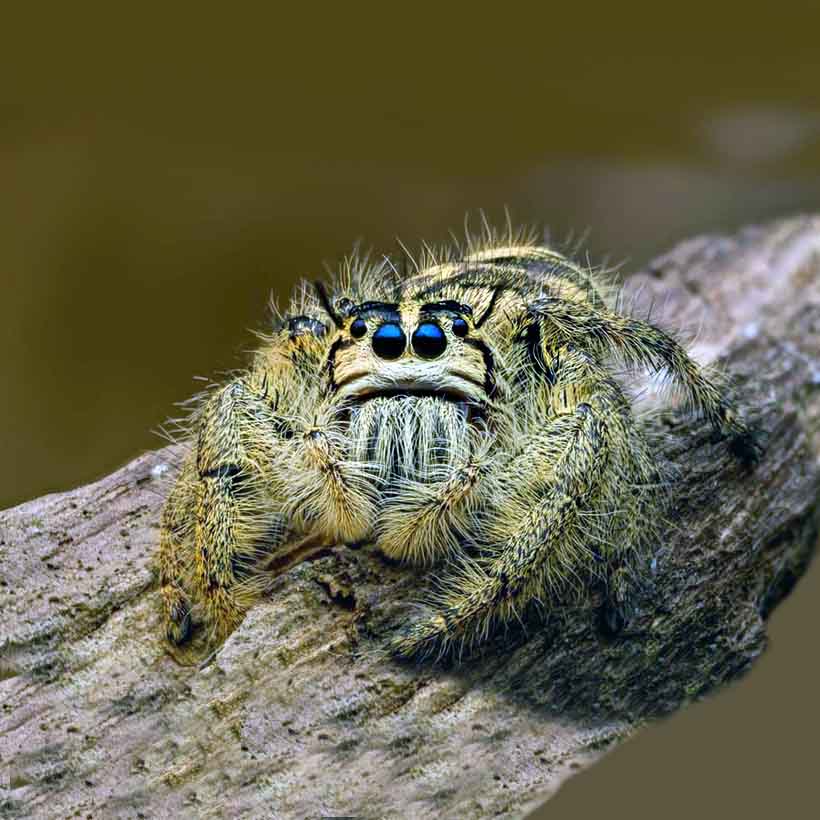
And now things are getting really interesting for Phidippus regius owners
Many of the most spectacular experiments on jumping spider intelligence were conducted with Portia.
It’s important to note this.
One shouldn’t automatically apply findings from a single genus to each of the more than 6,000 species of jumping spiders.
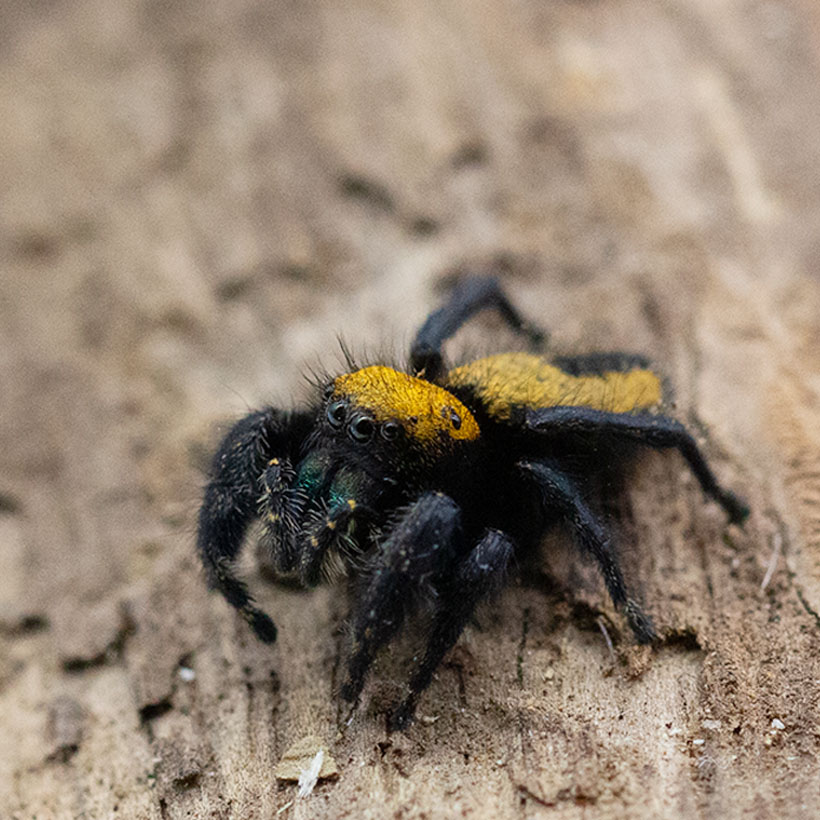
But now there’s also some very exciting research being conducted directly on one of the most famous jumping spiders of all:
Phidippus regius.
In 2025, a study was published that examined whether P. regius can distinguish between different members of its own species.
During their first encounter, the test animals showed clear interest in one another.
When the same spider reappeared later, their behavior changed.
If, on the other hand, a different spider was presented, the interest increased again.
The researchers interpret the results as evidence that Phidippus regius can distinguish familiar individuals from unfamiliar ones and retain information about them for several hours.
This is particularly noteworthy because Phidippus regius are not highly social animals like humans, monkeys, or sheep.
They are mostly solitary.
Nevertheless, their nervous system seems capable of processing the information
“I already know this spider”
from
“This spider is new”
.
For owners of Phidippus regius in particular, this is likely one of the most exciting discoveries of recent years.
So does your jumping spider recognize you, too?
Here, we need to remain scientifically rigorous.
The fact that Phidippus regius can distinguish between other jumping spiders does not automatically mean that your jumping spider recognizes you as an individual person.
To date, there is no convincing evidence that a P. regius recognizes its owner in the same way that a dog or cat does.
However, that doesn’t mean she can’t tell you apart at all.
Jumping spiders react to movement, shape, contrast, and experience. They can also learn and get used to recurring stimuli.
So if your jumping spider eventually seems less wary around you, it may well have learned that:
This regularly recurring stimulus is not an immediate danger.
However, we don’t currently know whether this leads to an individual concept of “my human.”
That’s an important distinction.
So, as smart as a sheep after all?
Now let’s return to our original question.
No—at least, that cannot be seriously claimed from a scientific standpoint.
There is no universally accepted intelligence test where one could simply say:
Jumping spider: 70 points.
Sheep: 70 points.
So just as smart.
A sheep has entirely different cognitive specializations.
Sheep are social mammals and, for example, have an impressive ability to recognize faces.
In a well-known study, sheep were able to recognize up to 50 other sheep’s faces over a period of more than two years.
In another experiment, sheep even learned to distinguish between photographs of human faces. They were subsequently able to recognize faces they had been trained to recognize from a slightly different perspective. A human caretaker with whom they were very familiar was even identified in photographs without any prior training.
This is a completely different cognitive world from that of a jumping spider.
A direct comparison would therefore make about as much sense as asking:
Which is more powerful—a race car or an excavator?
The race car is incredibly fast.
The excavator, on the other hand, can move things that the race car would be completely useless at handling.
Both are optimized for different tasks.
The same is true of brains.
So the more interesting question isn’t: How smart is she?
With animals, we often look for a hierarchy.
Humans at the top.
Then monkeys.
Then dolphins.
Then dogs.
Then maybe birds.
And somewhere way down at the bottom come insects and spiders.
But modern cognitive research is making this very idea increasingly problematic.
Evolution doesn’t build brains to win an intelligence test.
It builds nervous systems that must solve specific problems.
For a jumping spider, that means:
Recognizing prey.
Estimating distances.
Distinguishing dangers.
Calculate jumps.
Find suitable paths.
Store information.
Make decisions.
And sometimes follow a plan, even though the actual goal is no longer visible at the moment.
Your brain seems to be remarkably capable of handling exactly this kind of world.
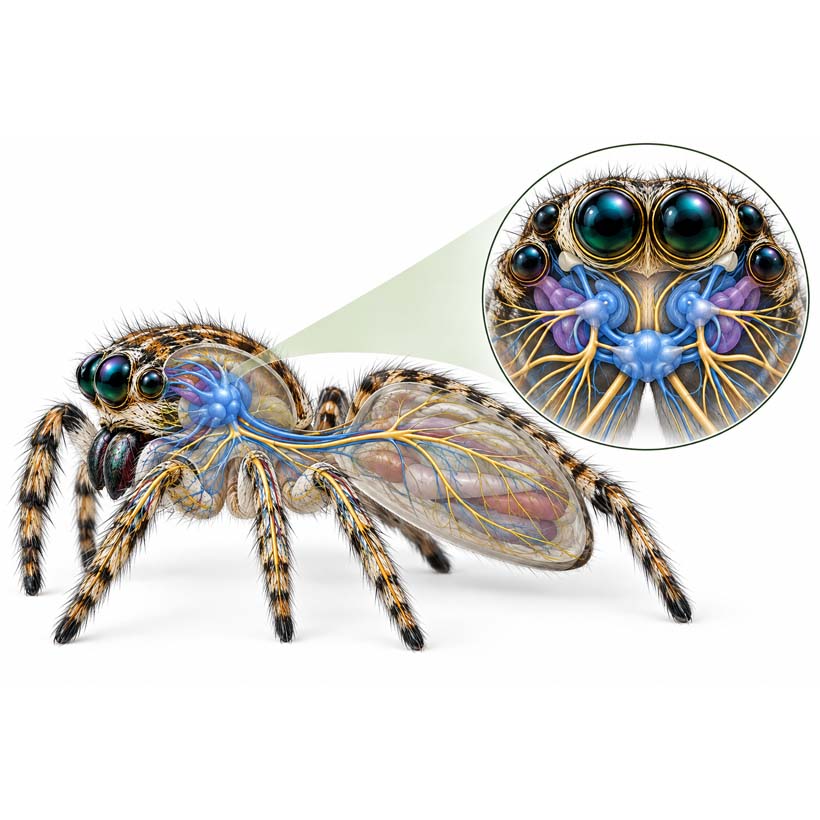
Eight eyes do not mean eight identical images
Part of this capability is likely due to the jumping spiders’ extraordinary visual system.
Their eight eyes perform different functions.
The large front compound eyes, in particular, provide exceptionally detailed vision. Other eyes, on the other hand, take in a wide area of the surroundings and are sensitive to movement.
You can think of it, in simple terms, as a surveillance system:
The outer cameras report:
“Something’s moving!”
Then the jumping spider turns its body toward it.
Now the high-resolution main eyes take over:
“What exactly is that?”
Researchers describe this system as a form of selective visual attention: Different eyes provide different streams of information, which the nervous system then integrates.
Perhaps this is precisely what gives rise to some of the behavior that makes jumping spiders seem so observant to us.
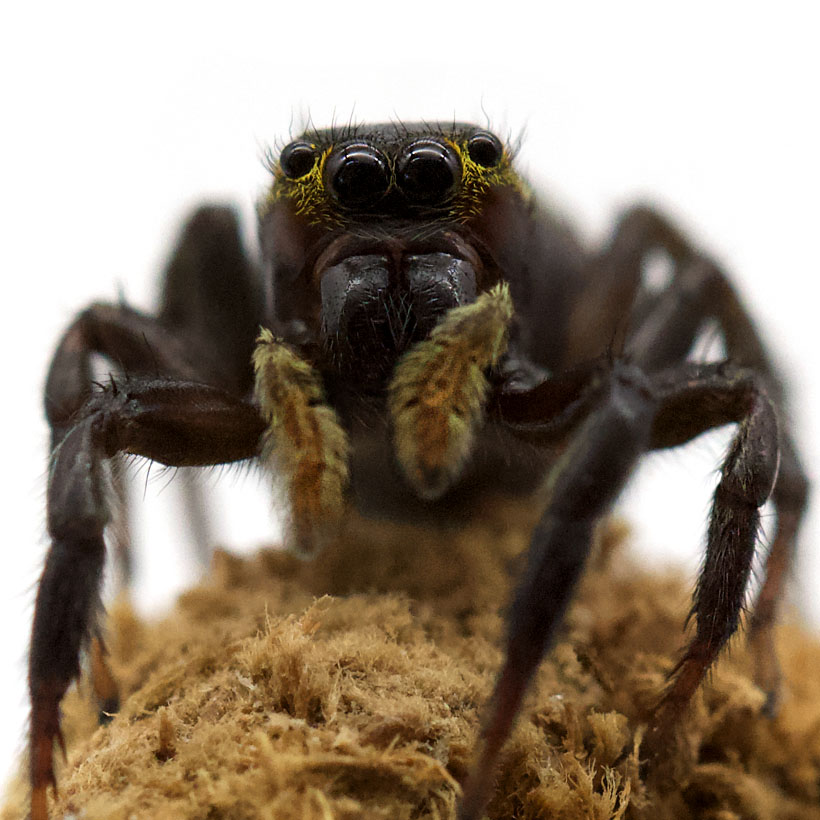
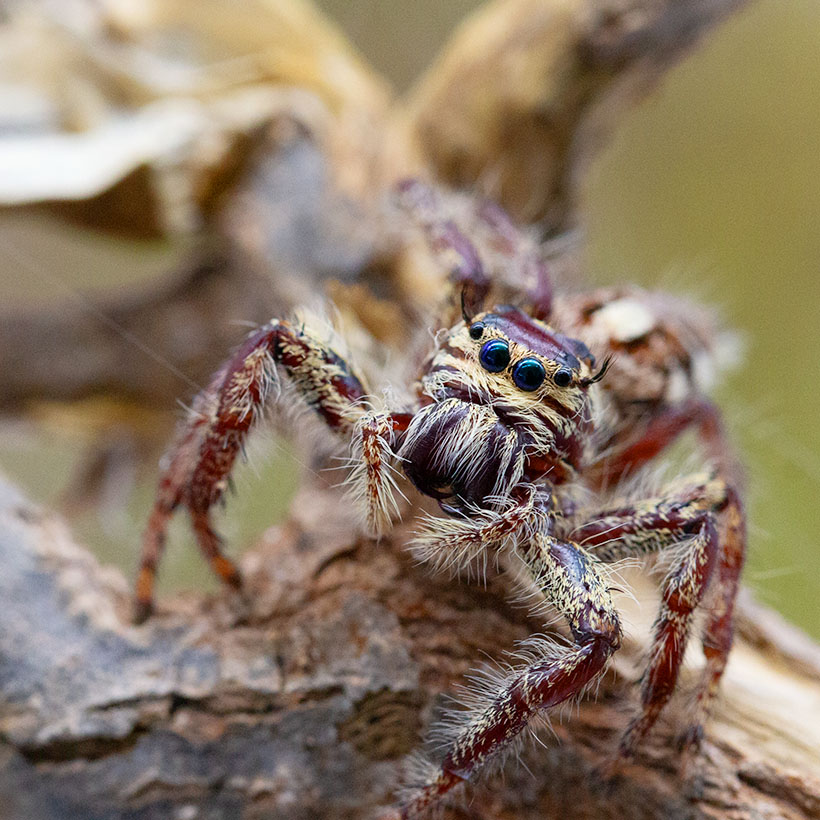
When your jumping spider looks at you, it’s actually processing information
Of course, we shouldn’t anthropomorphize jumping spiders.
When a Phidippus regius turns its head—or rather, its thorax—and stares at us with its large compound eyes, it’s probably not thinking:
“Ah, Frank’s back.”
At least, we can’t say that.
But what we can say with a fair degree of certainty by now is:
She is by no means just a little automaton that reacts to stimuli according to a fixed program.
While she sits there looking at you, her nervous system is processing information.
She decides which stimulus to pay attention to.
She can store experiences.
She can modify her behavior based on new experiences.
And in at least some species of jumping spiders, this processing can go so far that they choose a complicated detour, distinguish between quantities, or recognize an individual they have seen before.
How does a jumping spider think?
We don’t know.
And maybe that’s exactly the most fascinating part of the story.
We can set up experiments.
We can observe what decision a spider makes.
We can test what it remembers.
We can check whether it changes its strategy.
But we can’t find out what this information processing feels like to a jumping spider.
Perhaps the question itself is phrased too humanly.
After all, a jumping spider doesn’t have to perceive the world the way we do.
Its reality consists of movements, vibrations, contrasts, distances, potential jumping targets, prey, and danger.
And within this completely different world, it apparently possesses a remarkably powerful decision-making system.
Conclusion: Not as smart as a sheep—but as smart as a jumping spider
So is a jumping spider as smart as a sheep?
No. This comparison doesn’t hold up scientifically.
But actually, it would almost be a shame to try to make jumping spiders interesting only by comparing them to a mammal.
After all, their actual abilities are impressive enough on their own.
Jumping spiders can learn.
They can change their strategy.
Some can distinguish between quantities.
They recognize complex movement patterns.
They can store information in short-term memory.
Portia can choose complicated detours and follow a target that is temporarily out of sight.
And recent research even suggests that our well-known Phidippus regius can recognize individual members of its own species.
Perhaps, therefore, the question shouldn’t even be:
“Is a jumping spider as intelligent as a sheep?”
But rather:
How does an animal that fits on a fingertip manage to do all these things with such a tiny nervous system?
And so far, science has only a partial answer to that very question.
The more we learn about jumping spiders, the clearer it becomes that:
Behind those big eyes lies much more than one would initially expect from such a small creature.
If you have any further questions, please leave them in the comments below the article.
Leave a Reply
You must be logged in to post a comment.