


Too many Isopods in your terrarium? With proper planning, you can manage your Isopod population without letting them go hungry or releasing them into the wild. These five steps will help you care for a growing group responsibly.
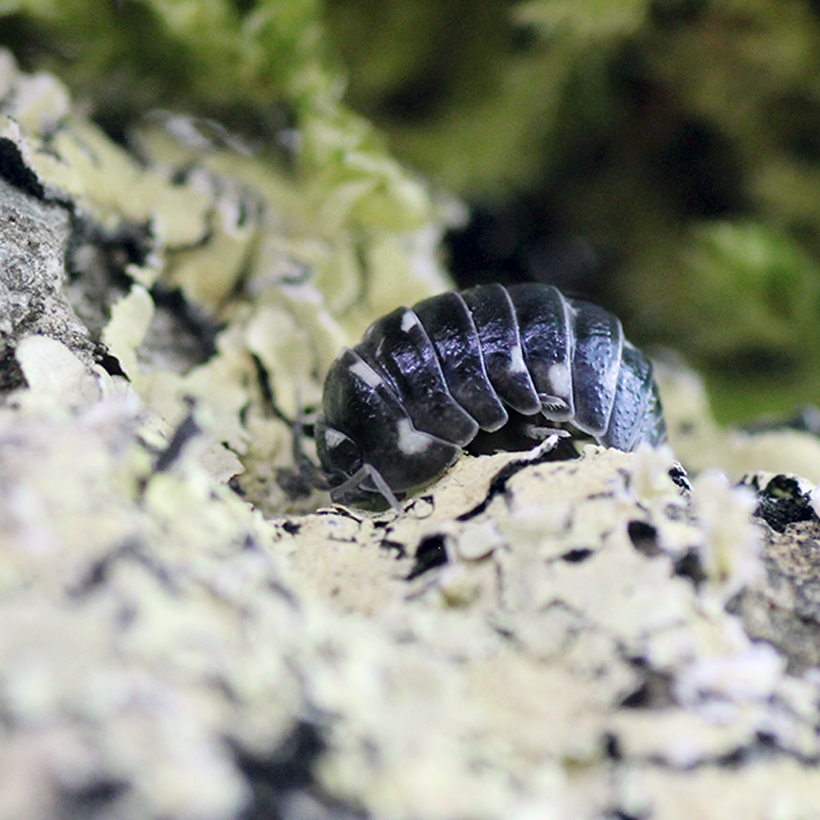
Groups that reproduce particularly rapidly, such as Porcellio laevis “Panda,” can outgrow the space originally intended for them. Don’t wait until animals start dying. However, having many animals at a single feeding site does not necessarily mean the area is overcrowded.
1. Assess inventory and available space
Check regularly to see how much food is being consumed, where the animals are finding shelter, and what condition the ground is in. Is there still enough leaf litter and wood? Can the animals move between suitable areas? Is the wet zone remaining stable?
A sudden drop in fertility is not necessarily evidence of a genetic breakdown. Temperature, age, nutrition, and other stressors may also be factors. Look for the cause rather than automatically classifying the group as permanently infertile.

2. Regulate woodlouse populations by providing more space
Divide the group among suitable containers or increase the usable floor space. Set up the new space completely before moving the group. An existing, safe, and well-ventilated pen may be sufficient.
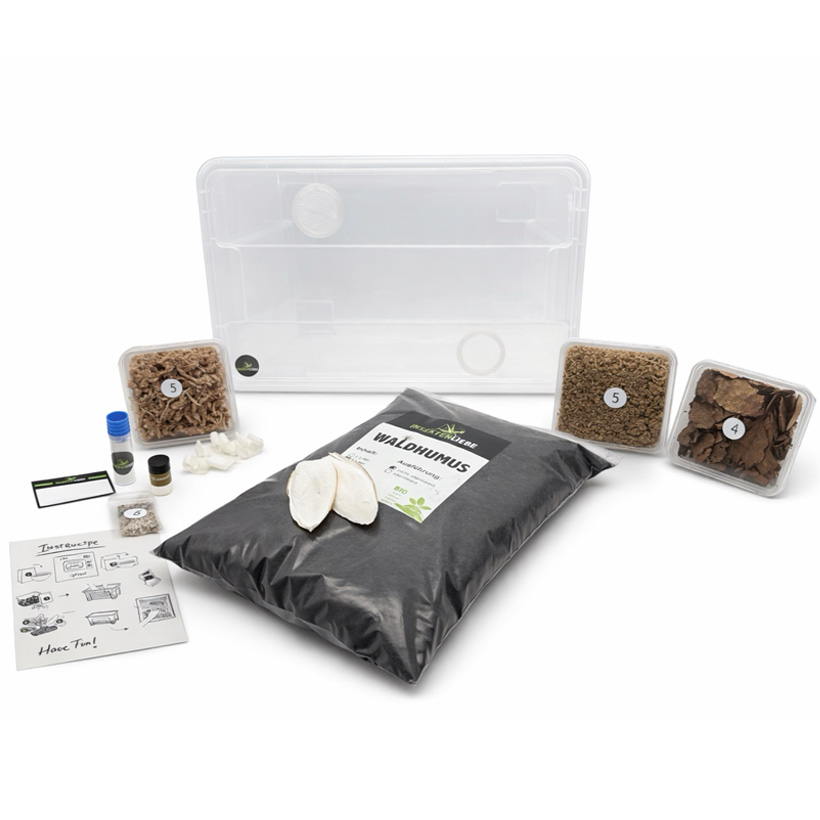
If you don’t have a suitable larger box, our Isopod Complete Set L is one option. Choose the version that matches the material you already have. However, an additional box only solves the space problem temporarily if the group continues to grow and you don’t plan to give any away.
3. Find customers early on
Talk to experienced owners or reputable specialty stores before you have to give away a large number of animals. Specify the species, approximate number, size, and how they’ve been cared for so far. Only give away animals whose condition you can assess accurately, and honestly describe any abnormalities.
If you would like to offer us offspring, please inquire in advance. We do not automatically accept them; acceptance depends on the species and our needs. Do not ship any animals without prior consultation. The new owner should have the housing arrangements ready.
4. Measure out the right amount of supplemental food
Avoid giving excessively large additional portions and remove leftovers. However, foliage, rotten wood, calcium sources, and an adequate water supply should be maintained. Deliberately starving a group to the point where only the strongest animals survive is not responsible herd management.
The amount of supplemental food should be based on actual intake. Reducing waste does not mean cutting back on basic nutritional needs. Nor does it allow for an accurate prediction of a decrease in the number of young animals.
YOUR READING TIP · Measuring Out the Right Amount of Donkey Feed
Distinguish between staple foods and economical supplements.
5. Regulate woodlouse breeding and plan new acquisitions
Before starting each new group, assess how much space and time you have available on a long-term basis. Label species and color variants clearly so you can keep track of them. Separating males and females later on is difficult with very small animals and does not reliably prevent potential offspring from being born immediately.
Do not use predators or competing species as a quick fix. This creates additional maintenance requirements and uncontrollable losses. A mixed population is no guarantee of a stable equilibrium.
Why Stopping Isn’t the Solution
Animals raised in captivity do not belong in the forest, garden, or compost. Even for species believed to be native, their exact origin, associated organisms, and impacts are not easily determined. A previous local determination cannot be used as general approval for other cases.
When removing leaves and substrate, be on the lookout for any unnoticed young animals. Store such material in an escape-proof container for the time being. Your responsibility doesn’t end with the easily visible adult animals.
YOUR READING TIP · Identifying and Caring for Baby Isopods
Take the next generation into account when it comes to care and relocation.
Still unsure? Feel free to ask us your question in the comments section below the article.



Leave a Reply
You must be logged in to post a comment.