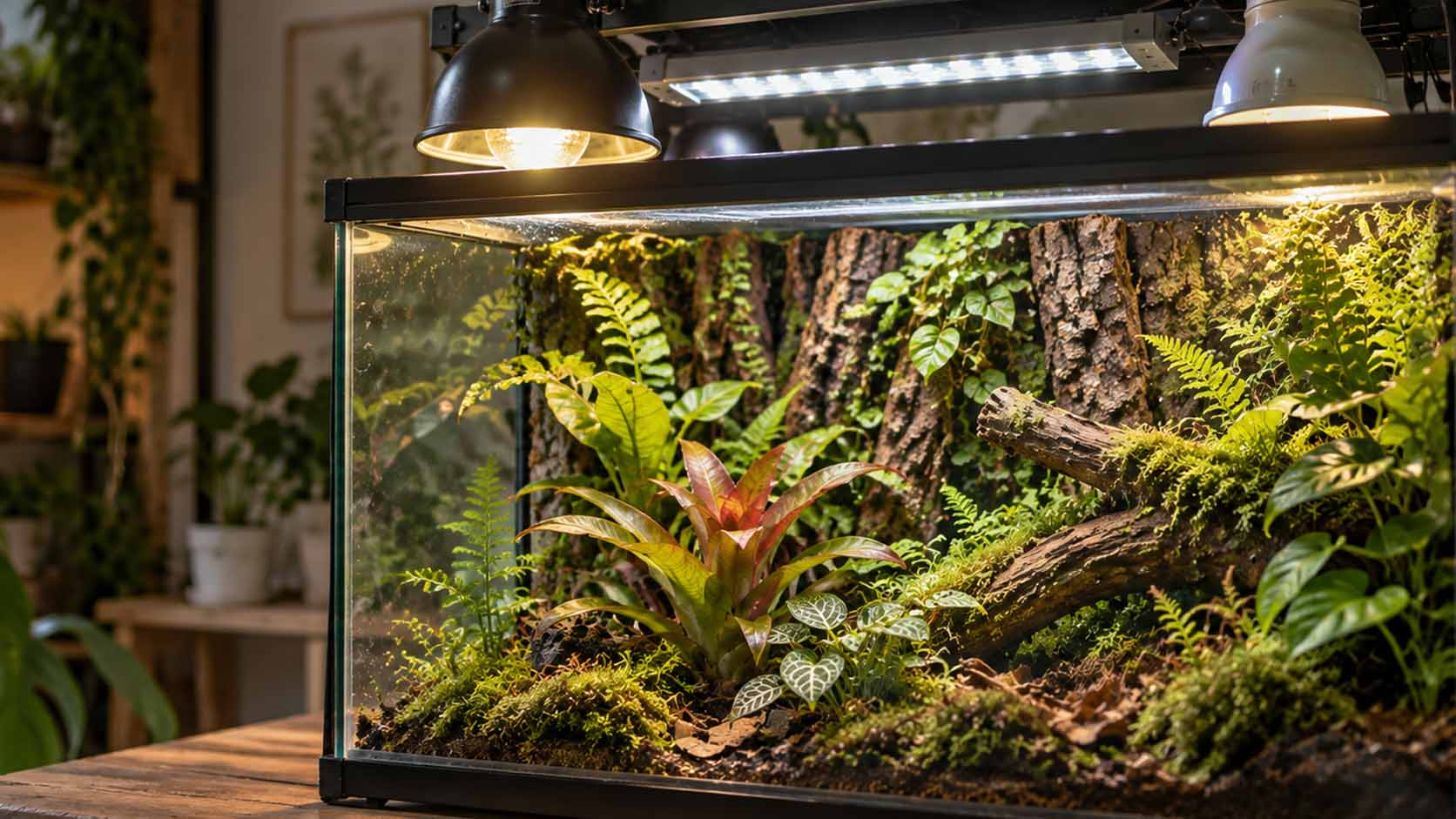


What kind of terrarium lighting is best for your jumping spider, mantis, or isopod tank? Here, you’ll learn when our invertebrates need their own lamp, when the plants in particular benefit from the light, and how to choose the right products.
Go directly to your animals: Jumping spiders · Mantises · Isopods · Millipedes · Tarantulas and scorpions
Your pet sets the tone.
First, determine the lighting, temperatures, and, if necessary, UVB exposure that your species requires. Then, choose the appropriate equipment. Not every terrarium needs all three.
An Overview of Terrarium Lighting for Our Animal Groups
This overview provides you with a general guide to the animals in our selection. Requirements may vary within a single animal group. Therefore, the care instructions for your specific species remain crucial.
| Your Pets | What is the purpose of lighting? | Especially important |
|---|---|---|
| Jumping spiders, e.g., Phidippus regius | Bright daytime lighting | Also check the temperature at the upper resting spot |
| Mantises, e.g., Hierodula spec. “Kalimantan Blue” | Daylight and appropriate temperature | Take into account the distance from the ceiling and the molting area |
| Isopods and millipedes | Supplementary lighting, especially for plants and for observation | Provide leaves, hiding spots, and moist retreat areas |
| Tarantulas and scorpions | Subdued lighting depending on the setup and species | Provide sheltered living spaces and allow for a period of darkness |
| Planted Invertebrate Terrariums | LED lighting suitable for planted terrariums | Light the plants, shade the animals’ hiding spots |
Light and heat: two different functions
Light provides daytime illumination and nourishes your plants. A standard daylight LED is a common choice for this purpose. However, it does not replace a targeted heat source.
Heat helps your animals reach the temperatures appropriate for their species. A heat lamp may be necessary for this. A comparison between the care requirements and the measured temperatures in your terrarium will show whether you need one.
UVB plays an important role for many reptiles. However, a bright lamp does not automatically provide UVB. If your reptile species requires UVB, you’ll need to include a suitable light source in your setup.
What kind of lighting is best for your pets?
Jumping spiders: Light for seeing and hunting
Jumping spiders like Phidippus regius are active during the day and hunt by sight. Bright daytime lighting is therefore an essential part of the setup. For a small terrarium, a compact LED is a good option. It should illuminate the living area well, while leaves and cork continue to provide hiding spots.
Jumping spiders are often found high up. Therefore, be sure to check the temperature where your spider builds its web. Whether the heat from the lighting is sufficient depends on the species, location, and room temperature. Increasing the brightness does not automatically solve a temperature problem.
Repto Flat LED: It can be placed on top of a suitable glass or gauze cover. The flat design is practical when there’s limited space above the terrarium. You can choose between two brightness levels.
Repto Compact LED: The ideal choice if you want to mount the lamp on the edge of the terrarium and adjust its angle using a gooseneck. Before purchasing, check to make sure the clamp fits your terrarium.
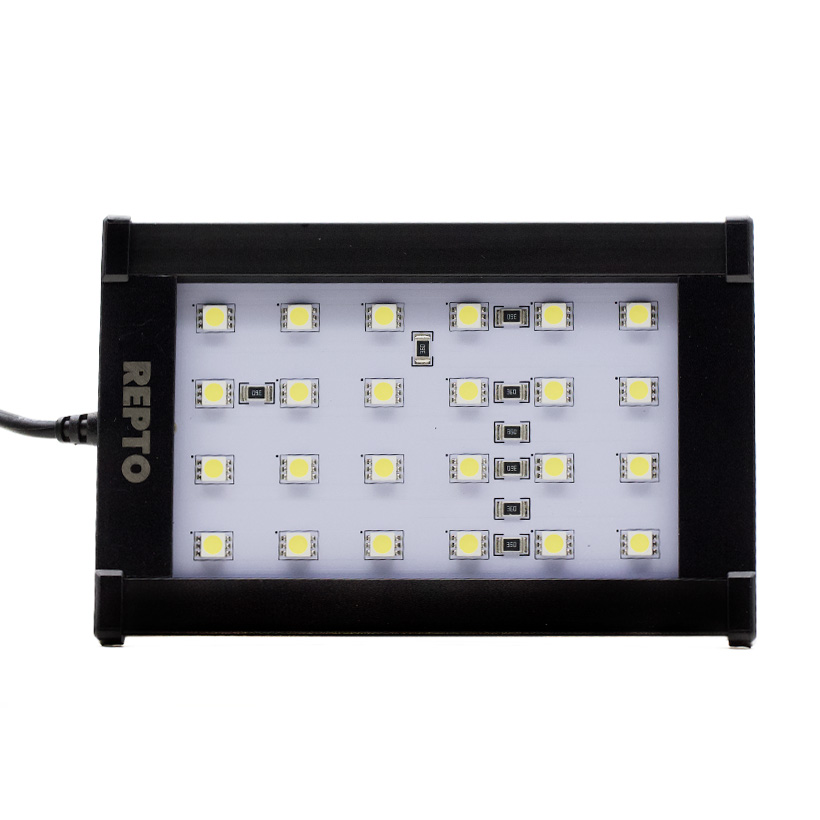
Repto Flat LED
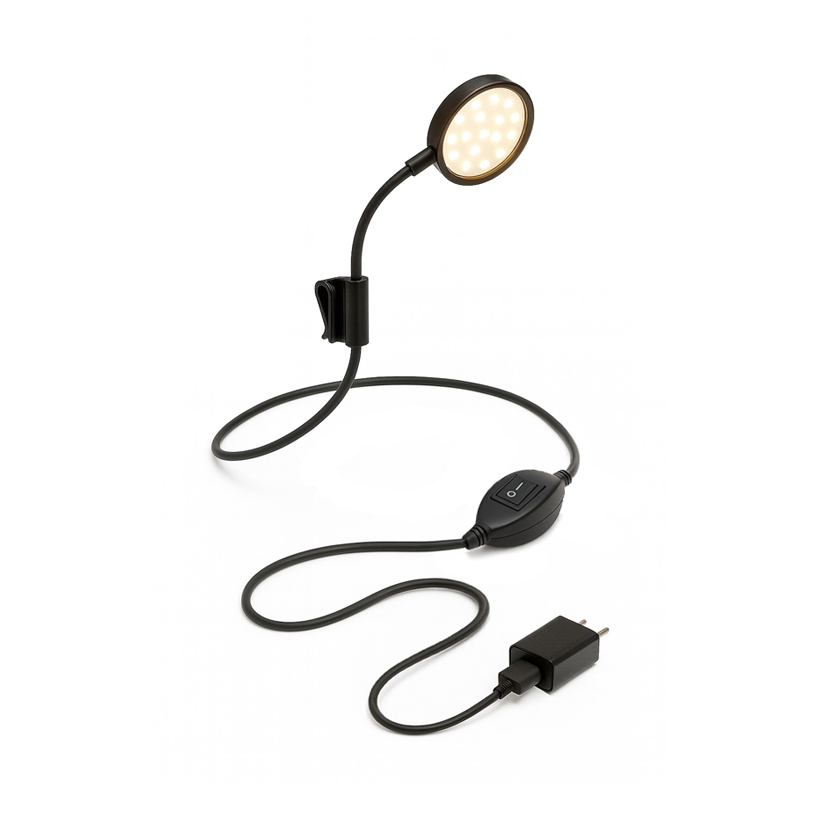
Repto Compact LED
You can find more information about setting up a habitat and daily care in our guide to keeping jumping spiders.
Praying Mantises: Planning for Daylight and Temperature Together
When keeping mantises, in addition to lighting, you should pay special attention to the temperature requirements of your specific species. For Hierodula spec. “Kalimantan Blue,” for example, we recommend a daytime temperature of about 25–28 °C. An LED light can provide the daytime lighting. You can determine whether additional heat is needed by checking the set-up in your terrarium.
Mantis often hang from the ceiling and also use this area for molting. Therefore, plan the distance from the lamp based on where they actually spend their time. A warmer upper zone should not cause the molting area to become too hot. Other mantis species may have different needs.
For a small mantis terrarium: We recommend the AquaLighter Pico Tablet LED as a compact daytime light. It can be placed on top of a suitable terrarium lid or rearing box and is powered via USB. A compatible 5-V USB power adapter is not included. If you don’t already have one, you’ll find the right USB adapter listed right with the lamp. This is not a dedicated heat lamp. If your terrarium doesn’t reach the temperature required for your species with this lamp, you’ll need to add an additional heat source. For tall or densely planted tanks, choose lighting based on the plants’ needs, as described further down in this article.
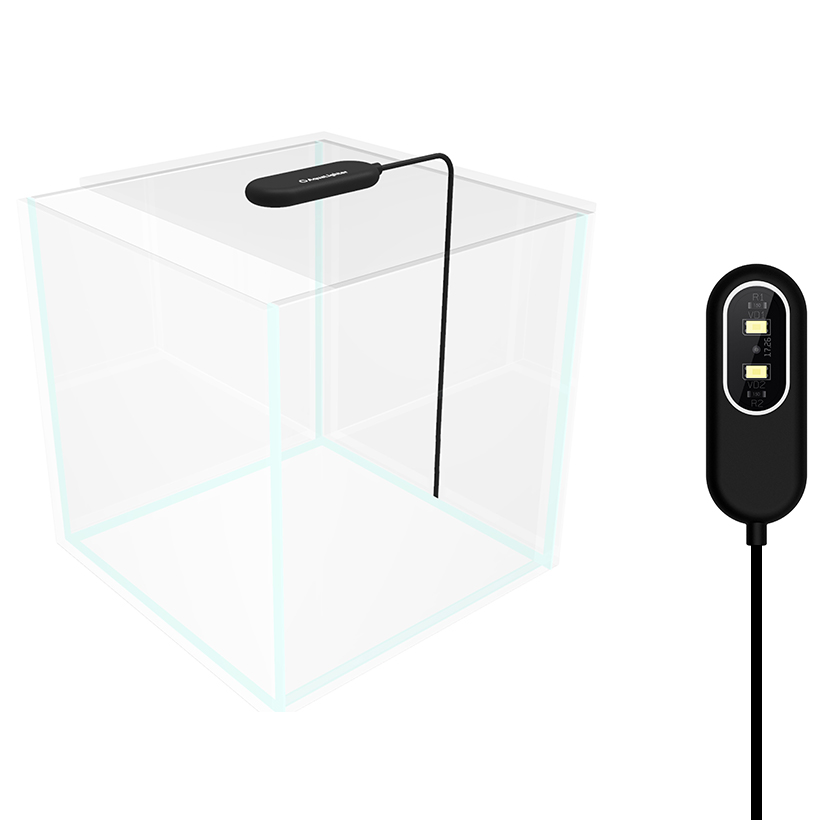
AquaLighter Pico Tablet LED
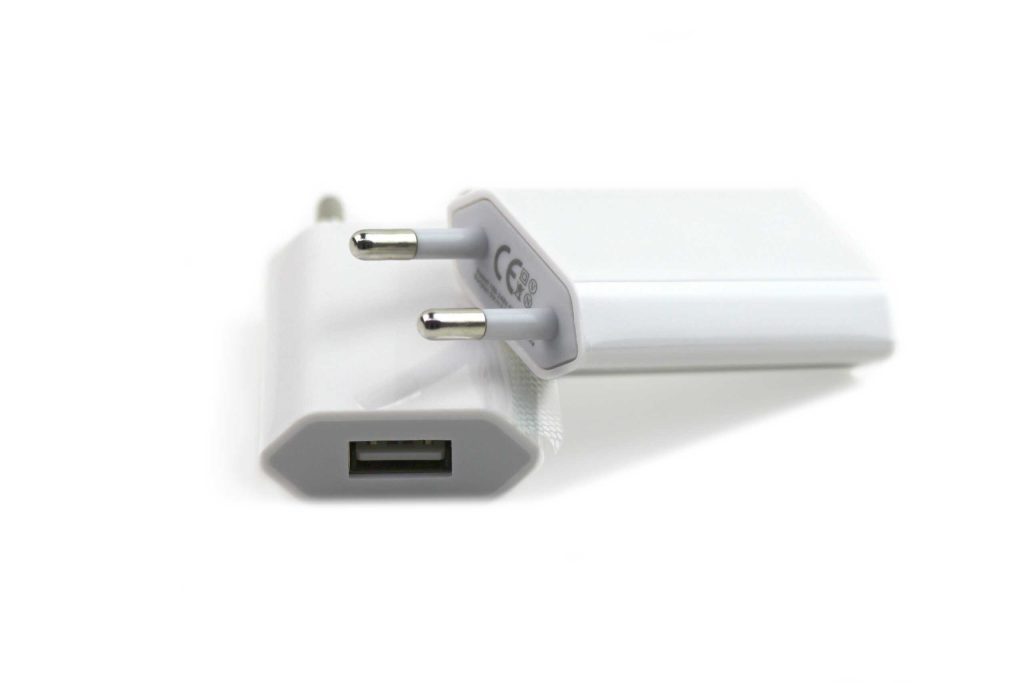
USB adapter 5V
Isopods: Providing Light for Plants, Preserving Hiding Places
An unplanted isopod tank usually doesn’t need its own light. If you want to care for plants or observe your isopods more closely, subtle LED lighting can be helpful. Leaves, bark, and other sheltered spots remain important. Don’t shine a light on every hiding place.
For a small, planted isopod terrarium: The HOBBY Terra Fix & Easy Nano LED is a good option if its mounting system is compatible with your cover. If you’d prefer to place the lamp on top of a suitable cover, the Repto Flat LED shown above is an alternative. The choice depends on the mounting method and the plants’ needs—the Nano LED is not specifically designed for woodlice.
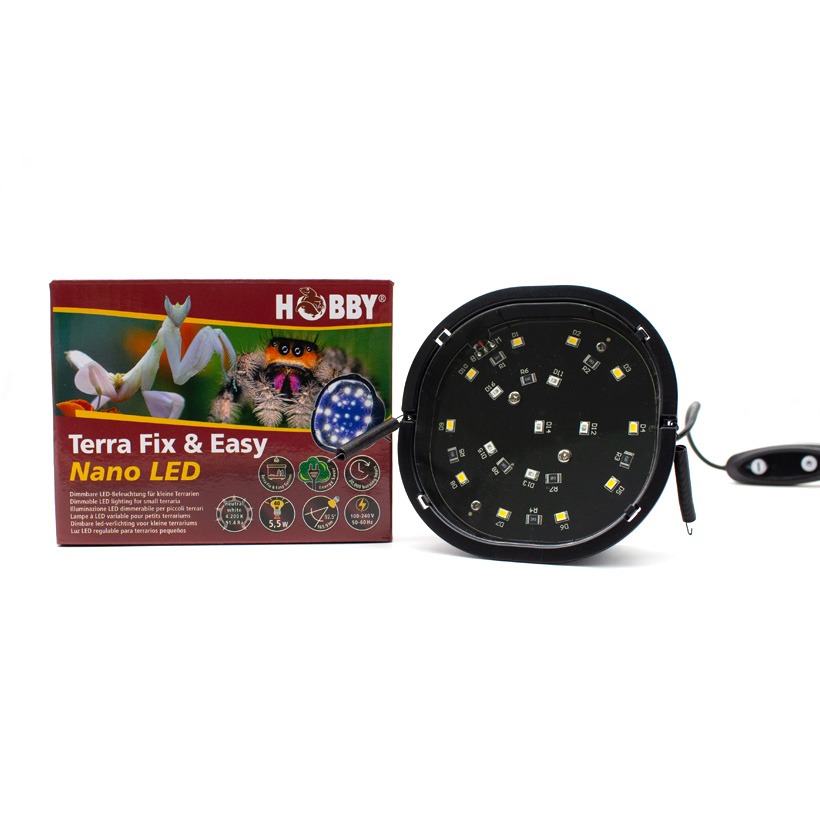
Hobby Terra Fix & Easy Nano LED
Millipedes: The Substrate Takes Center Stage
For millipedes such as Atopochetus dollfusi, additional lighting for the animals themselves is usually not necessary. This species spends a lot of time in the substrate and is primarily active at dusk or at night. Suitable substrate, humidity, and sheltered spots are more important here than a particularly bright lamp.
For a compact, planted display terrarium: The Repto Flat LED is an option if you want to place a flat light on top of a suitable cover. Its two brightness settings make it easy to adjust. The Nano LED shown with the Isopods is also a viable option if it can be mounted properly. The key factors are the plants’ needs, the height, and the surface area of your tank—not the type of animals you keep.
Repto Flat LED
Tarantulas and Scorpions: Respect Their Hiding Places
If the enclosure is unplanted and has a distinct day-night cycle: An additional bright light is not necessary for many tarantula and scorpion setups. The specific needs of your particular species are the deciding factor. Any heat source you may need should be chosen independently of the lighting.
For a small planted terrarium: The HOBBY Terra Fix & Easy Nano LED is a good option for your plants if its mounting fits the tank. Aim the light at the plants and keep hiding spots in the shade. For larger or densely planted tanks, the following section will help you.
Hobby Terra Fix & Easy Nano LED
Which LED is right for your planted terrarium?
A few low-maintenance plants have different needs than a densely planted terrarium. So don’t just look at whether the tank seems bright to you. What matters is whether your plants get enough light in their respective locations.
This makes a difference, especially in tall terrariums. At the top, a plant sits close to the light, while at the bottom, leaves, branches, and cork can block a lot of light. Therefore, choose lighting that’s appropriate for the height and the planted area. Still, be sure to leave some sheltered areas for the animals.
Arcadia Jungle Dawn LED BAR: For planted terrariums with specific lighting requirements. Choose the model based on height and planted area, not on maximum output.
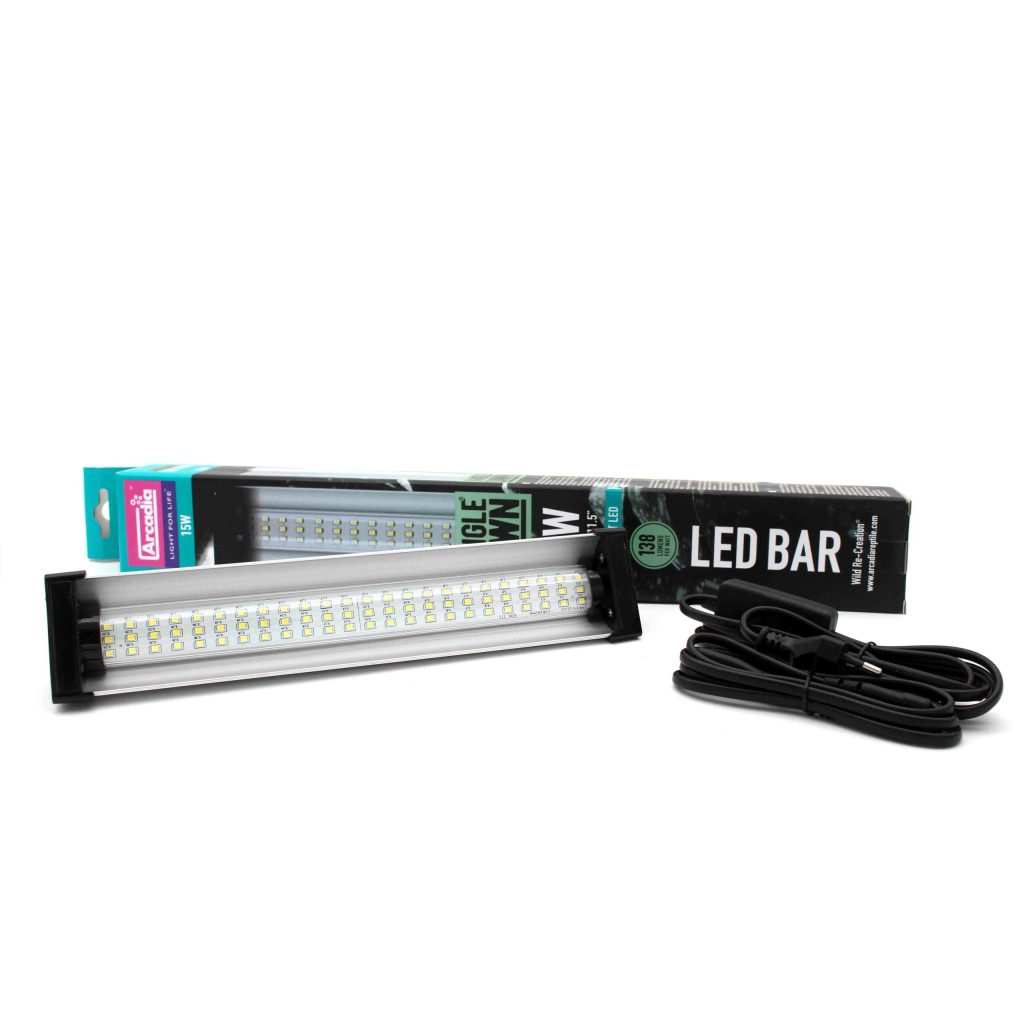
Arcadia Jungle Dawn LED BAR
After setting up your setup, keep an eye on how your plants are growing. Weak, long shoots may indicate a lack of light. Brown leaves, on the other hand, can have various possible causes. So be sure to check the moisture levels and location before you simply buy a stronger lamp.
When do your invertebrates need extra warmth?
First, measure the temperatures your set-up terrarium reaches during the day and at night. If they fall within the appropriate range for your species, additional heating may not be necessary at all. A lamp should not generate heat that you then have to laboriously remove from the terrarium.
If your species requires additional heat from above, the heat source must be suitable for the enclosure. Small terrariums for jumping spiders and mantids, in particular, do not benefit from a one-size-fits-all recommendation for a powerful heat lamp. For burrowing isopods and millipedes, the substrate must also remain intact to serve as a suitable hiding place.
Arcadia Halogen Heat Lamp: A possible heat source for suitable setups with sufficient spacing. Not a standard recommendation for small breeding boxes; power, temperature control, and measured temperatures must be appropriate.
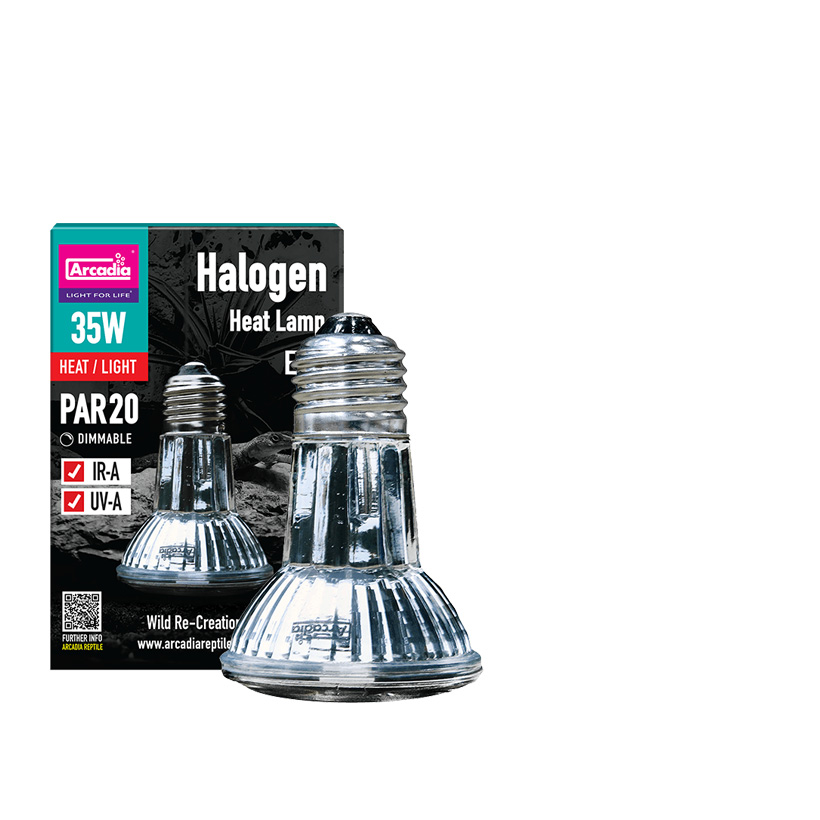
Arcadia Halogen Heat Lamp
Don’t rely solely on the wattage. Room temperature, ventilation, and distance can affect the result. Check both the warm spot and the cooler area. Small terrariums, in particular, can heat up quickly. LEDs also give off heat.
A heat source and its control system must be compatible. Be sure to follow the manufacturer’s instructions. If additional heat is actually needed at night, plan for a suitable solution that does not emit visible light. A bright daytime lamp should not simply be left on for this purpose.
How to Set Up Lighting for Everyday Use
Install the lamp so that it fits the terrarium. Before purchasing, check that the mounting bracket, cover, and light fixture are compatible. Maintain the specified distances from animals, plants, and other equipment. Hot parts must be out of reach of your animals. The socket and mounting bracket must be approved for the light source.
Plan a regular daily routine. A timer makes it easier to turn the lights on and off. For Phidippus regius, our linked care guide recommends about twelve hours of lighting per day, for example, from 8 a.m. to 8 p.m. Don’t apply this across the board to all animals: the duration and seasonal adjustments depend on your specific species. Keep the lights off at night.
Test the setup before moving in. Let the equipment run for several day and night cycles. LEDs also give off heat: Take measurements at the living area and in the cooler retreat area. For Isopods and millipedes, also check to make sure the moist areas in the substrate remain intact. Check again when you change the light bulb or if the room gets warmer.
Do our invertebrates need a UVB lamp?
For the common setups described here for jumping spiders, mantises, isopods, and millipedes, a special UVB lamp is not part of the standard equipment. Therefore, don’t buy one just because it’s labeled a “terrarium lamp.” Even a scorpion observation lamp serves a different purpose. If you keep reptiles, plan their UVB requirements separately according to each species.
Observing Scorpions Briefly
A special light for scorpions is not a substitute for natural light and is not essential equipment. It can make the typical glow visible under UV light. Use it only briefly for observation, and then allow the animals to return to darkness.
HOBBY Fluro LED: Special light designed for brief observation of fluorescent scorpions; not intended for continuous nighttime lighting.

Hobby Fluro LED
Frequently Asked Questions About Terrarium Lighting
Is the light from the room sufficient?
That depends on the location, your pet’s species, and the plants. A room that seems bright to us may not provide enough light for the terrarium. Having your own lighting makes it easier to control the daily cycle. Direct sunlight coming through a window is not a reliable substitute and can cause the terrarium to heat up significantly.
How many watts does my terrarium need?
There’s no general formula for this. Watts describe power consumption, but they aren’t the only factor determining suitability. The key factors are the lamp’s purpose, its light distribution, the distance, and—in the case of heat sources—the actual temperatures reached.
Does a light have to stay on at night?
Constant nighttime lighting isn’t automatically part of proper care. Plan for a period of darkness. Even blue or red light isn’t completely invisible. If you want to briefly observe your animals, keep the lighting as minimal as possible and turn it off again afterward.
What information would help us advise you?
Tell us the type of animal you have, the dimensions of the terrarium, and the room temperature. It’s also helpful to include a photo of the setup, details about the plants and cover, and the temperatures you’ve already measured. That way, we can work together to determine exactly what equipment you need.
Still unsure? Feel free to ask us your question in the comments section below the article.
Leave a Reply
You must be logged in to post a comment.