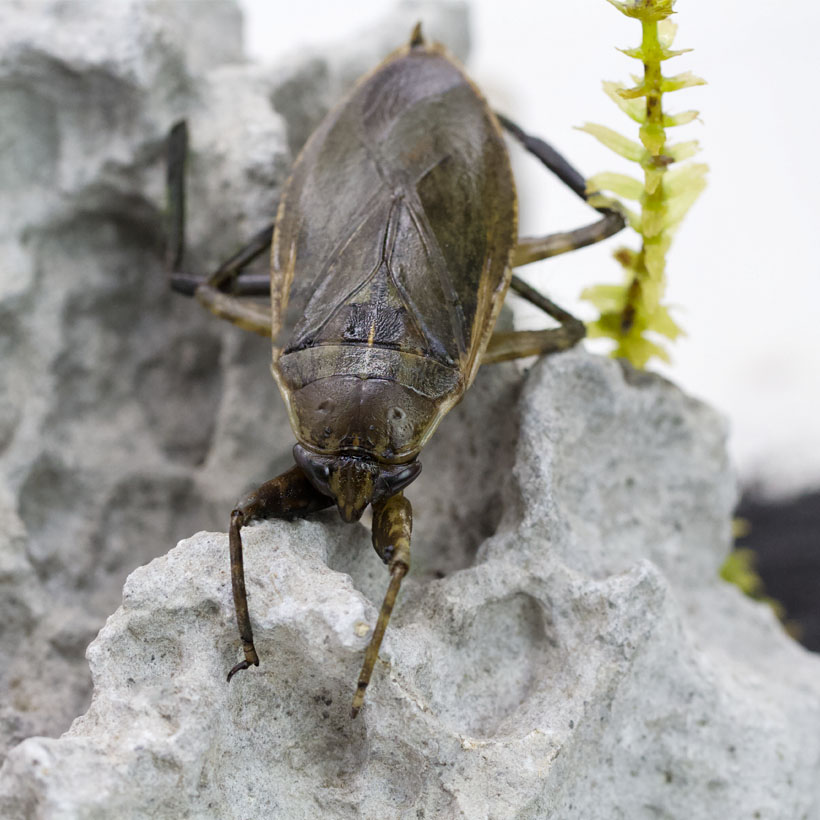
Lethocerus africanus
9,95 € incl. VAT, plus shipping
Out of stock

Medium

Nigeria

< 80 mm

22°C – 26°C
For connoisseurs and enthusiasts – a real highlight among aquatic insects
Lethocerus africanus is undoubtedly one of the most fascinating representatives of African aquatic insects. As a member of the genus of giant water bugs, it is one of the largest aquatic insects in the world and immediately attracts everyone’s attention with its imposing physique, which can reach up to 8 cm depending on the animal. With its flat, torpedo-shaped body, strong tentacles and striking dark coloration with lighter accents, this predator not only looks impressive, but is also a perfectly adapted hunter in the water.
Lethocerus africanus is robust and comparatively easy to care for as long as the basic requirements are met. An aquarium with a base of at least 40 x 30 x 30 cm, a well-structured arrangement of plants, stones and cork bark, as well as an air gap above the water surface is essential. As this species breathes air, free access to the surface must always be guaranteed. The water temperature should be between 22 and 26 °C. A gentle current and good water quality also contribute to their well-being. It is advisable to secure the tank with a lid, as Lethocerus is quite capable of flying.
The species is not very picky when it comes to food: earthworms, insects, smaller fish or frozen food animals such as shrimps are readily accepted. However, Lethocerus africanus should not be socialized with other animals due to their powerful sucking proboscis – they are solitary animals and potential predators.
Breeding is successful in spacious, warm and humid tanks with a shallow water area. Females lay their eggs above the water surface on plants or cork – where they are guarded by the male and regularly moistened. After about 2-3 weeks, the larvae hatch and can be fed with small insects or water fleas. Breeding is exciting, but demanding, as the larvae are sensitive to poor water quality.
Lethocerus africanus is not an animal for beginners, but an impressive enrichment for lovers of exotic aquatic insects – fascinating in appearance, behavior and biology.