

General information:
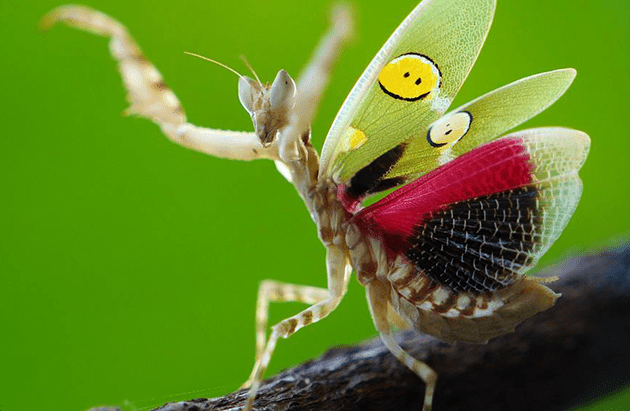
Creobroter gemmatus, also known as the flower mantis, imitates flowers like all of its species. Both sexes have a green coloration as adults and a so-called eyespot of different shape on the wings. The eyespot is yellow and oval with a black border. Newly hatched larvae, so-called mimicry, are red/black in color and look like ants. In the course of further moults, the larvae take on a green-beige coloration and after the mature moult a green coloration. When it assumes a threatening posture, you can see that the hind wings are colored pink at the base and have a deterrent spot.
A very beautiful and above all interesting species in an optimal size. It is really exciting to observe the physical changes in the individual stages.
Ootheca deposition is a fascinating process. You can really see them pumping and weighing.
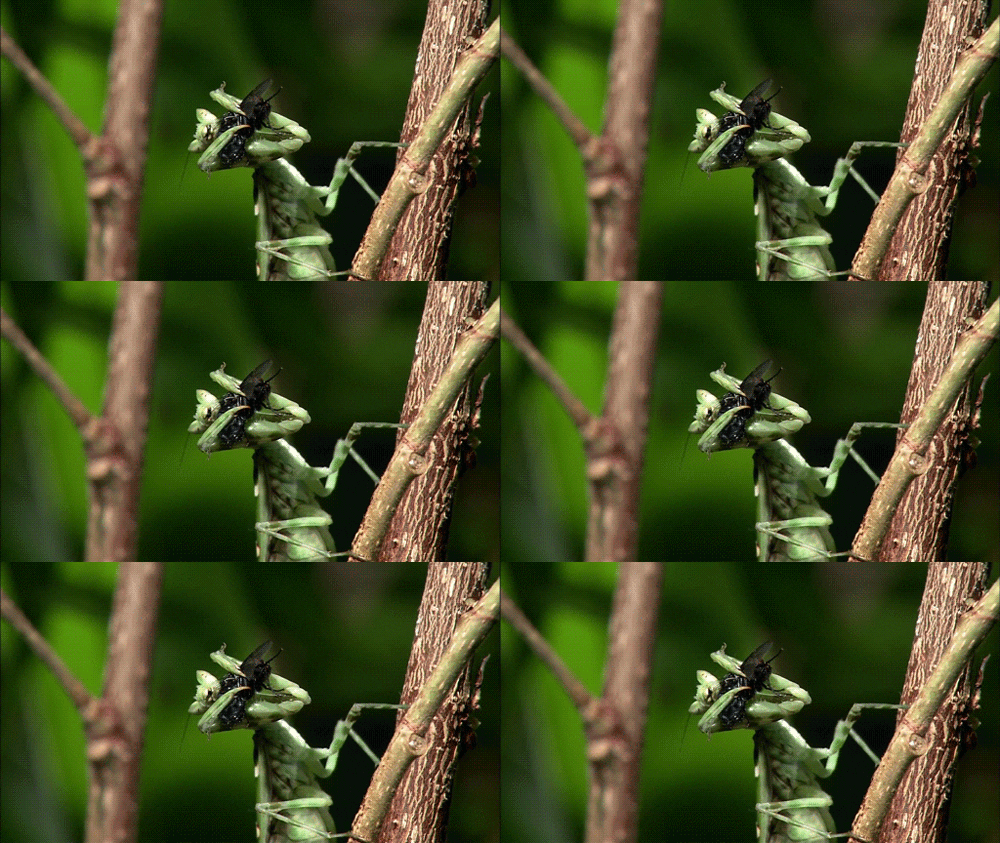
They love to eat and eat a lot, so you can also study their eating behavior extensively.
Size:
Male: 3.5 cm
Female: 4.5 cm
Food:
Small fruit flies Drosophila melanogaster
Large fruit flies Drosophila hydei
Large fruit flies Lucilia sericata
Blowflies Calliphora sp.
Habitat:
Creobroter gemmatus can be found on flowering, highly branched shrubs. There they wait for nectar-seeking insects. It has a relatively large catchment area that extends across South, Southeast and East Asia. The humidity there is relatively high, ranging between 50-60% during the day and rising by a further 10% at night. The temperature there is between 25-30°C during the dayand, very importantly, not below 20°C at night. The large catchment area also means that the species is not particularly susceptible to minor fluctuations.
Please note that it is no longer found at higher altitudes where temperatures fall below 20° C.
Keeping in the insectarium:
L1/L2:
At this stage I keep them in groups in a 500 g/ml packaging cup. I have cut out an opening in the lid and rinsed a ladies’ stocking underneath. I have added a vent on the side for safety. To start with, I use untreated wood wool as a climbing surface and kitchen towels as a substrate. There must always be twice the size of the mantids at the bottom so that moulting can proceed smoothly. I spray the substrate in the evening so that it is almost dry the next evening. When spraying, it is better to start a little more cautiously and work your way up slowly. Waterlogging is more dangerous for your animal than slightly lower humidity. There should always be enough Drosophilas in the container. I change the kitchen towel at least once a week, depending on how they rage in it. If you buy individual animals now, you can go straight on to L3/L4.
L3:
Creobroter gemmatus are moderately aggressive towards conspecifics. Separation at the L3 stage is therefore sufficient. In general, however, it is always better to keep them individually. This causes the animals less stress and they also grow faster. I therefore keep them individually in a 500 g/ml packaging cup. There, too, I have I cut out an opening in the lid and rinsed a ladies’ stocking underneath and added ventilation to the side. I continue to use wood wool for climbing and kitchen towels as a substrate, as they are cheap and hygienic. It is really important that you always leave twice the size of the mantids at the bottom so that the moulting can take place without complications. In the evening, spray the kitchen towel so that it is almost dry the next evening. I always offer them food in the form of Drosophilas. The container is cleaned once a week.
(L4 Creobroter gemmatus foraging)
from L4:
I use BraPlast tins measuring 18.5 x 18.5 x 19.0 cm. There should be twigs and flowers like in their natural environment. The mantis does not distinguish between real flowers and plastic flowers. It can adapt its coloration to its surroundings. The otherwise white areas of its body then turn yellowish, brownish or pink. You can gather your own experiences here.
If you take branches from nature, place them in the microwave for 20 seconds or at 100°C beforehand.°C in the oven for 15 minutes. This will kill all the mites and other parasites that you have brought with you and that could cause you problems later. Here too, the motto is less is more. Praying mantises are lurking hunters, so you shouldn’t pack it full. Leave space for moulting, as this is the most dangerous time in your guest’s life.
Reproduction:
Sex determination:
First of all, we need to know what a female is and what a male is.
In all mantid species, females can be distinguished from males by the number of visible abdominal segments (Sternites).
Males have 8 sternites, whereas females only have 6 visible ones. This can often be seen with a magnifying glass from L3, from L4 and L5 it can also be seen with the naked eye. In most cases it is also sufficient to look at the last segment on the abdomen. If it is as long and wide as the previous segments, it is a female. If the last segments become increasingly smaller and narrower, it is a male. Note that in the adult stage the male also has an elongated last segment.
In the subadult larval stage, the males of this species can also be recognized by their thickened and longer antennae. If you are unsure, you are welcome to send me photos by e-mail and I will then determine the gender for you.
If you would like to know more about sex determination:
Sex determination of a praying mantis
Sexual maturity:
The females become adults after approx. 8 moults, i.e. in L9. Male Creobroter gemmatus after 7 moults, i.e. in L8. The females need another 2 weeks after moulting until they are ready to mate. Males only 1 week.
This means that the males become sexually mature one moult and one week before. This is a fairly unproblematic period, as the males live for around 2.5 months after moulting.
The difference between the sexes can be recognized from L3. This means you can keep the males slightly cooler than the females as a preventative measure. Please remember not to keep them below 20 °C.
So about 2 weeks after moulting the animals are ready to mate.
(Photo: Mating ofCreobroter gemmatus)
Mating:
I always mate the animals in the male’s insectarium. It is important to note that the males are good and agile fliers. I give the female a large food animal beforehand so that she is busy eating during the mating and doesn’t attack the male. This reduces the sexual cannibalism and at the same time ensures better oothecae. Mating takes place as follows. The male jumps onto the female’s back and holds her with his front legs. Copulation can last up to 12 hours, so you can watch the spectacle in peace.
Oothek tray:
The first ootheca can be laid after just 2-4 days and can be delayed for up to 7 days. This is followed by 6-7 further oothecae at intervals. They are usually narrow and approx. 3-6 cm long. The ootheca can contain up to 50 eggs. In contrast to the free oothecae of cockroaches, mantis insects stick their roundish, elongated, shield-like, drop-shaped or packet-like oothecae to various substrates. They are often attached to the climbing facilities or to the gauze cover. To do this, they first apply a protein-containing secretion to the substrate. More of this foamy secretion is then released with spiral movements of the abdomen, and the eggs are deposited one after the other in the same substrate in such a way that they are arranged in a certain order and each occupy a compartment of the ootheca. Finally, the secretion is drawn out in a more or less long thread before it hardens into a sponge-like, very firm cocoon. Along the surface is the thinnest part from which the nymphs hatch. It can usually be recognized as a large-pored, seam- or comb-like strip. You can find out more about the ootheca here.
Incubation:
Hatching is strongly linked to temperature and humidity – at 29° C and 70% humidity, the 4 mm hatchlings hatch after approx. 5 weeks. Please feed the juveniles immediately after hatching, this will significantly reduce cannibalism.