

General information:
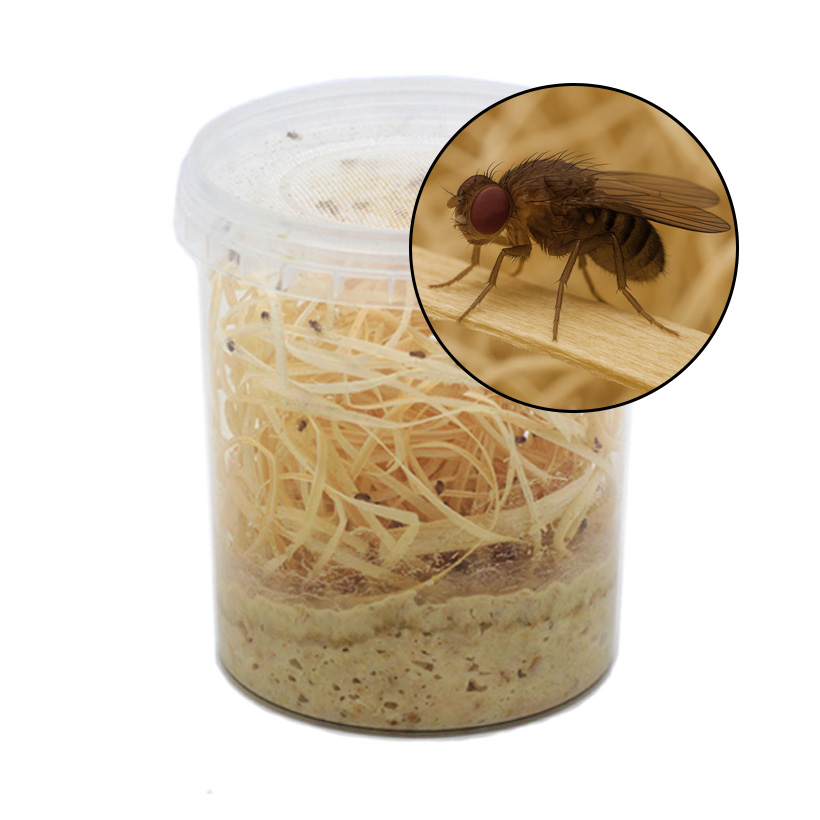
Drosophila hydei is the second relevant species in terraristics. At around 3 to 4 mm, it is slightly larger than Drosophila melanogaster. However, the development time increases significantly – as always, this is strongly dependent on temperature. As a rough estimate, a generation sequence of about 3 weeks can be expected.
Breeding:
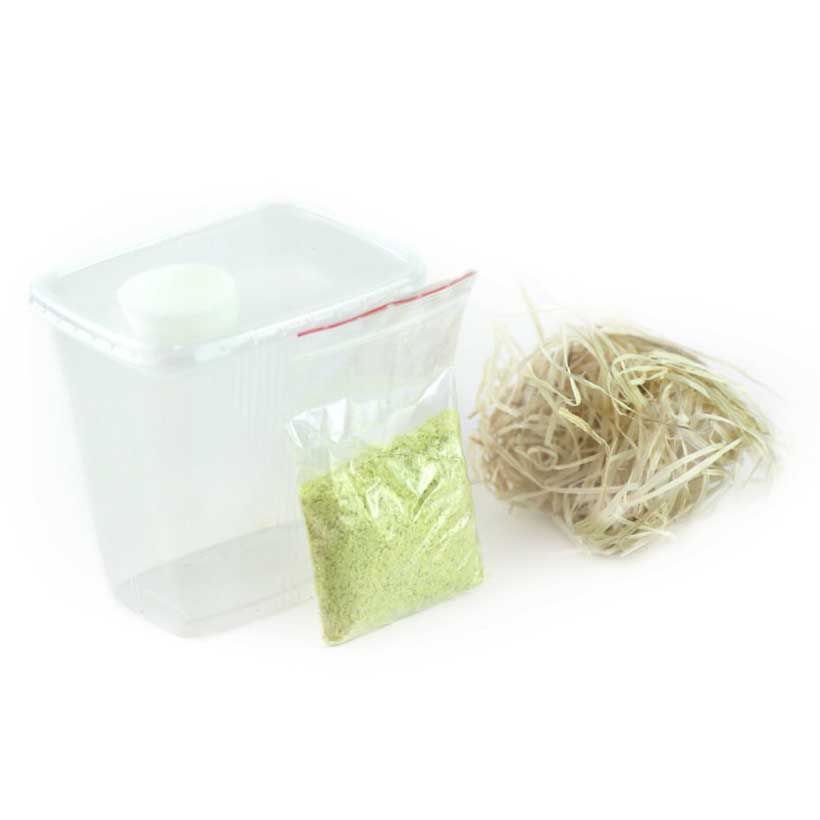
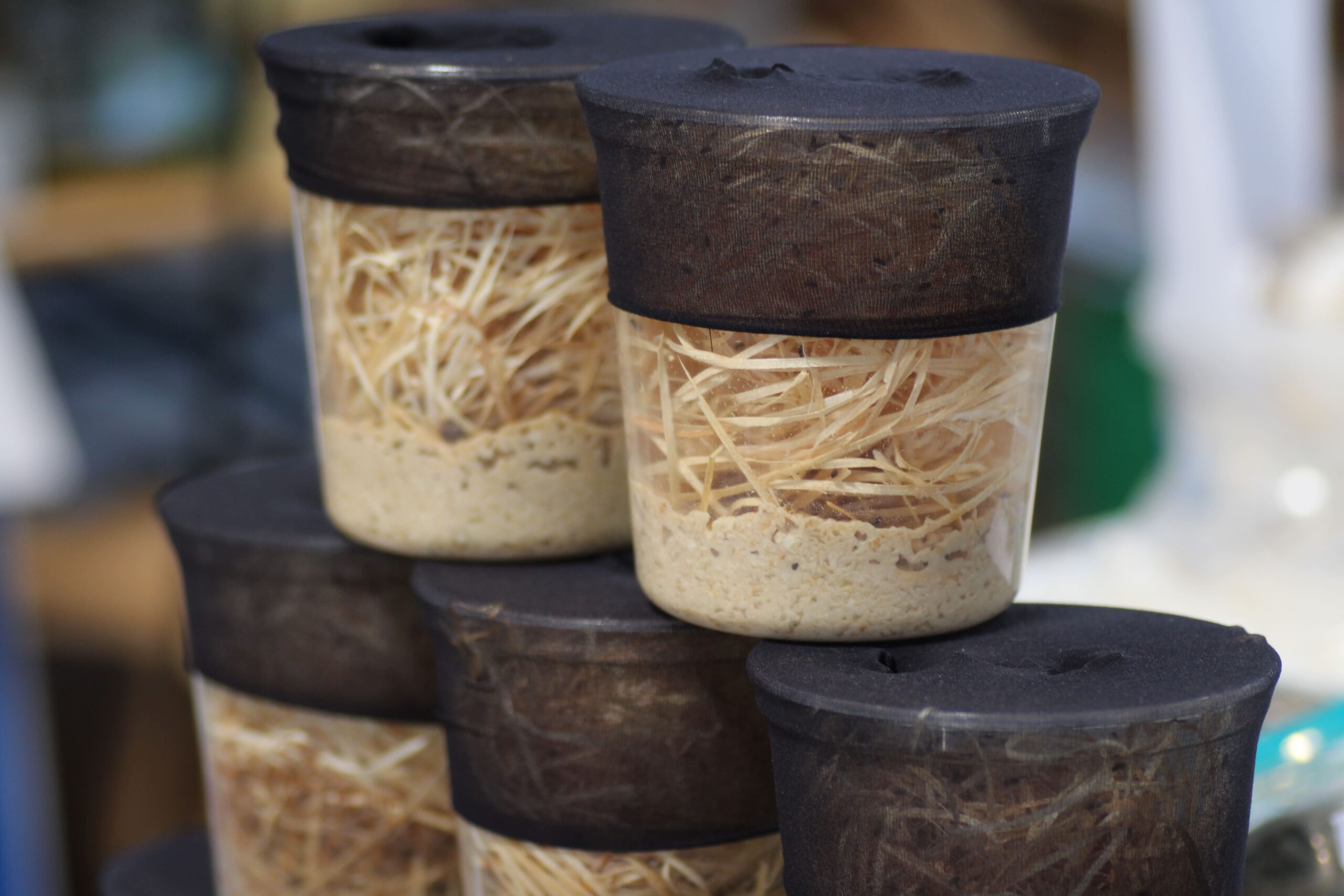
Breeding these animals is very easy and very inexpensive compared to other animals. I use washable glass containers or plastic containers with a capacity of 500-1000 ml for breeding. I fill them with the breeding substrate to a height of approx. 3 cm. Wood wool, egg cartons, crumpled paper or strips of paper from the shredder are placed on the substrate as a walking surface. As a rule, I stock the new breeding boxes with 20-40 flies, so that the larvae are stocked quickly. I do not heat the fruit fly hatchery but keep it at normal room temperature.
You should therefore keep the breeding cultures a little warmer and the containers with the already hatched animals a little cooler to increase their lifespan. Egg laying is best observed shortly after the cultures have been prepared, when the larvae are not yet disturbing. The eggs are preferably laid on the surface of the culture medium. The development period depends on the temperature.
During larval development, the animals moult twice. The length of the animals increases. The larvae burrow into the culture medium. To pupate, they usually leave the culture medium and migrate up the wall of the breeding containers.
Nutrient medium:
Drosophila larvae feed on yeasts. The culture medium must be such that it provides favorable growth conditions for yeasts. It should be firm enough so that nothing flows out when the container is turned over. However, the larvae must be able to bore into the substrate.
Ingredients for a breeding container in summer:
- 1 cube of baker’s yeast (1 packet of dry yeast)
- 2 teaspoons sugar
- 100 ml fruit vinegar (6 tablespoons)
- 40 g rolled oats (3 heaped teaspoons)
Ingredients for a breeding container in winter:
- 1 cube of baker’s yeast (1 packet of dry yeast)
- 1 tablespoon sugar
- 135ml vinegar (8 tablespoons)
- 1 bag of mashed potatoes
- Water (half of the liquid indicated on the packaging)
You do not need an antifungal agent such as Nipagin as the proportion of vinegar is very high. You can also leave out the yeast, as there are yeast cells on the feet of the breeding flies. However, this delays breeding considerably. Due to the presence of yeast, it must be clear to everyone that completely odorless breeding is not possible. In the beginning, the smell of vinegar predominates. The longer the culture stands, the more unpleasant the smell of the substrate becomes.
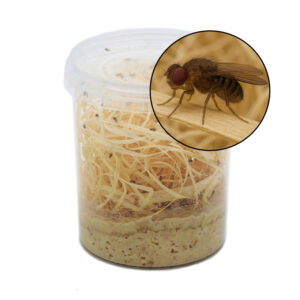
Large fruit fly
Large fruit fly – Ideal live food for hungry terrarium inhabitants The large fruit fly (Drosophila hydei) is a flightless breeding form and is one of the most popular food…
Mites are the biggest problem with Drosophila breeding. I therefore recommend using as many animals as possible when inoculating the new breeding tanks. This increases the number of larvae and their strong circulation in the breeding mash reduces the multiplication of mites. In addition, the breeding boxes can be placed permanently in a water bath. This prevents the mites from moving from one cup to the next and also prevents the fruit flies from spreading throughout the house.
Feed Drosophilas:
Of course you can go to your wife’s or girlfriend’s closet to “borrow” a pair of tights. This builds many bridges from the breeding cup to the insectarium. However, I usually break some out anyway and tights are far too expensive in the long run, especially if you get the wrong ones. You can easily avoid any trouble with the opposite sex by simply putting the breeding cups in the fridge for a few minutes. Then you can open the can at your leisure, knock the animals out and even dust them with a vitamin preparation (Korvimin ZVT). The fruit flies will remain in a state of torpor for a short time, which will not harm them, the eggs or the larvae.