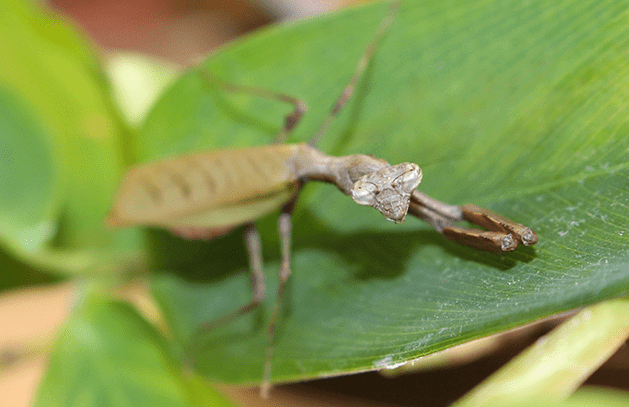


General Information:
Acromantis japonica are very fascinating praying mantises that show the typical boxer mantid boxing with their tentacles when threatened. The tentacles are alternately moved forwards in a circular motion and then retracted again, which makes them look like they are in a boxing match. This makes the inside of the tentacles visible. The Japanese Boxermantis exhibits low intraspecific aggression. This means that cannibalism is rare and they are well suited to being kept in groups. Also b hanks to the boxer behavior, cannibalism rarely occurs during mating and the male often remains on the female after mating, only to mate again some time later. The so-called boxer behavior serves the communication of this very interesting mantid species.
Size:
Male: 3.0 cm
Female: 3.5 cm
Very beautiful small species that can be easily accommodated in any home and are very suitable for beginners.
Food:
I feed them every 2-3 days. As nymphs I fed them about 4-6 fruit flies. Adult females can eat 2 to 3 blowflies. Adult males 1 to two gold flies. I have not noticed this species becoming overweight or obese as they simply stop taking food beforehand.
L1/L2: Springtails Collembola or freshly hatched
Ovenfish Thermobia domestica
L3/L4: Small fruit flies Drosophila melanogaster
L5/L6: Large fruit flies Drosophila
L7/adult: blowflies Calliphora sp. or adults
Ovenfish Thermobia domestica
The males, as sub-adult flesh flies, prefer the somewhat smaller gold flies as adults. They like to wait for their prey, but will also occasionally be active
Habitat:
Acromantis japonica is found in Japan, Korea, Taiwan and neighboring eastern China. There they live mainly in bushes and on trees. Although they are a tropical species, the room temperature of 22°C does not seem to slow down their growth. As far as humidity is concerned, it is also rather atypical for a tropical species. During the day 60-70%, at night 10% higher. I spray once a day, half an hour before the lights go out.
Care in the insectarium:
L1/L2:
L1 nymphs are black and look like small ants. Her legs have ribbons in alternating colors. Nymphs are very active, they love to run around everywhere. Later, as adults, they are content to hang motionless from a stick or the lid of their shell. At this stage I keep them in groups in a 500 ml plastic container. I cut out an opening in the lid and put a ladies’ stocking underneath. At the beginning I use untreated wood wool as a climbing surface and fine clay granules as a substrate. I don’t use springtails for this species as they seem to be stressed by them. There must always be twice the size of the mantids at the bottom so that moulting can proceed smoothly. In the evening, I spray the cup so that it is dry the next evening. When spraying, it is better to start a little more cautiously and work your way up slowly. Waterlogging is more dangerous for your animal than slightly lower humidity. There should always be enough Drosophilas in the container so that they don’t eat each other.
L3/L4:
If they are frightened, they run or jump very quickly at this age to escape. I separate the animals from pre-subadult (2 more molts until adult). I use either cricket boxes, placed upright or 500ml plastic boxes. There should be branches like in their natural environment. If you take branches from nature, place them in the microwave for 20 seconds or at 100°C beforehand.°C in the oven for 15 minutes. This will kill all the mites and other parasites that you have brought with you and that could cause you problems later. Here too, the motto is less is more. Acromantis japonica are lurking hunters, you should not cram it full. Leave space for moulting, as this is the most dangerous time in your guest’s life.
Reproduction:
Sex determination:
First of all, we need to know what is a female and what is a male.
In all mantid species, females can be distinguished from males by the number of visible abdominal segments (sternites).
Males have 8 sternites, whereas females only have 6 visible ones. In this very small species I recognize the sex difference in the pre-subadult stage. It is usually sufficient to look at the last segment on the abdomen. If it is as long and wide as the previous segments, it is a female. If the last segments become increasingly smaller and narrower, it is a male. If you’re unsure, feel free to email me some photos, and I’ll determine the gender for you.
If you’d like to learn more about sex determination:
Determining the Sex of a Praying Mantis
Sexual maturity:
I look for the wings. If they are about 1/3 of the length of the later wings, then the following moult is the adult moult. The females become adults after about 8 moults, i.e. in L9. Male Japanese Boxermantis after 7 moults, i.e. in L8. The mantids need approx. 3 weeks after the mature moult until they are ready to mate. Overall, the lifespan is around 10-12 months for females and 7-8 months for males.
Mating:
To mate the Acromantis japonica, I transfer them to a large BraPlast box with lots of branches and hiding places. Beforehand, I give the female a large food animal so that she is busy eating during the mating and does not attack the male. This reduces the sexual cannibalism and at the same time ensures better oothecae. Mating takes place as follows. The male jumps onto the female’s back and holds her with his front legs. Copulation can last up to 12 hours, so you can watch the spectacle in peace. Mating is fairly unproblematic with Acromantis japonica, but I would not do without the precautions mentioned. The life expectancy after moulting is approx. 4-6 months. If breeding does not work, I increase the temperature of the breeding container to about 27°C, which increases the willingness to mate.
Here you can observe an encounter between the two sexes.
Ootheca storage:
The first ootheca is laid 2 weeks after mating. I put additional branches in the insectarium for this. Branch forks are very popular for laying. The oothecae are light to dark brown in color, approx. 5mm wide and 1.5cm to 2.5cm long. At temperatures around 24°C, 20-50 nymphs hatch after 30 days. You can find out more about ootheca here.
Incubation:
Hatching is strongly linked to temperature and humidity – at 29° C and 70% humidity, the 4 mm hatchlings hatch after approx. 5 weeks. Please feed the juveniles immediately after hatching, this will significantly reduce cannibalism.