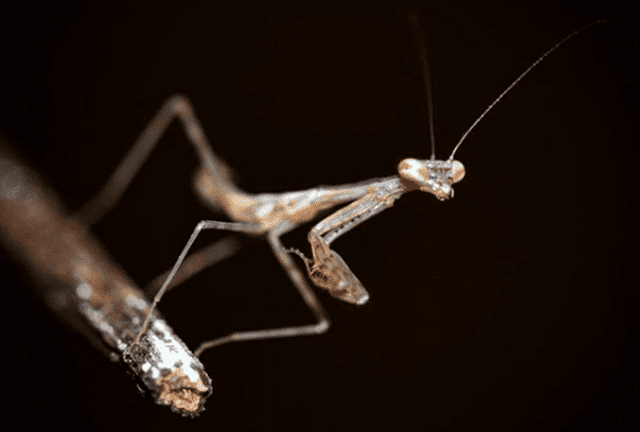


General information:
Praying mantises are ambush hunters. They often hang there motionless for days, ready to strike at the decisive moment. It doesn’t matter how much faster a fly can move, it depends on that one moment. The moment that decides whether to eat or be eaten.
The Miomantis paykullii behaves somewhat differently to its conspecifics and in my opinion this makes it a very interesting mantid. These very agile mantids don’t just hang out in one place in the terrarium as usual, but look for several different spots. Miomantis paykullii are relatively small and jumpy mantids. In case of danger, Miomantis flee with quick jumps. The males are very agile and good fliers and regularly use this to escape.
For an ambush hunter, it often actively catches its prey, which in other species can only be observed in very hungry mantids. Watching a praying mantis hunt is great fun and a welcome change of pace. I can therefore not only recommend Miomantis paykullii to every beginner, but I think you should have kept one at least once.
Size / life expectancy:
Males: 3.5 cm / Total 4 months (2 months to adult + 2 months as adult)
Females: 4.0 cm / Total 6 months (2 months to adult + 4 months as adult)
Food:
L1/L2: Small fruit flies Drosophila melanogaster
L3/L4: Large fruit flies Drosophila hydei
L5/L6: Gold flies Lucilia sericata
L7/adult: Blowflies Calliphora sp.
Habitat:
Miomantis paykullii inhabits steppes and dry areas in Africa, where it perches on shrubs, bushes and grasses . The distribution area is huge, including Egypt, Burkina Faso, Ivory Coast, Ghana, Cameroon, Kenya, Mauritania, Mozambique, Niger, Senegal, Chad, Togo, Uganda and Zimbabwe. huge. As with all mantids that are easy to keep, this is also a good indication that the species has not specialized in a particular environment, but is relatively insensitive to fluctuations.
Keeping in the insectarium:
L1-L3:
It is best to incubate the ootheca in a BraPlast box. This saves you the trouble of moving the animals, which is no fun with Miomantis paykullii due to their agile nature. I cut out an opening in the lid and used organza with hot glue as a ventilation grille. I also added a vent on the side for safety. To start with, I use untreated wood wool as a climbing surface and kitchen towels as a substrate. There must always be twice the size of the mantids at the bottom so that moulting can proceed smoothly. The nymphs should be kept slightly more moist than the larger animals. I spray the substrate a little every 2-3 days. When spraying, it is better to start a little more cautiously and work your way up slowly. Waterlogging is more dangerous for your animal than slightly lower humidity. There should always be enough Drosophilas in the container to provide food. I change the kitchen towel at least once a week, depending on how high the population density is.
from L4:
Due to their very pronounced intra-species aggressiveness, I set them individually from L4 and can recommend everyone to do the same. I go into the subject of terrarium size in more detail in the article “Terrarium size and ventilation“. You are also welcome to watch the video accompanying the article.
Reproduction:
Sex determination:
Sex determination can only be carried out reliably from L5 onwards. Only the number of segments provides reliable information in Miomantis paykullii. Male Miomantis paykullii have 8 segments and females only 6.
An absolutely fascinating feature of Miomantis paykullii is that it can reproduce by parthenogenesis. However, only a few offspring are produced by parthenogenesis, but these are still significantly more than in most other species where this is not possible. Therefore, even one female Miomantis paykullii is enough to produce offspring to ensure the survival of this species.
If you want to know more about sex determination, you can read the article Sex determination of a praying mantis.
If you are unsure, you are welcome to send me photos by e-mail and I will then determine the gender for you
Sexual maturity:
The females need 1-2 weeks after moulting until they are ready to mate. Males only 1 week. If you recognize the sex from L5 onwards, you can keep the males a little cooler to be on the safe side.
Even under the same husbandry conditions, you can get both sexes to reach adulthood and mate at the same time.
Mating:
Breeding is relatively easy, about two weeks after the adult molt you put males and females together and wait, the females should be well fed as always.
As soon as a male is near a female, he immediately jumps onto the female’s back without observing the female or waiting for the right moment. Even if the female tries to eat the male, the latter jumps onto his back so quickly and skillfully that the male can almost always escape
Oothek tray:
There can be up to 70 eggs in an ootheca, although the average is 20-40 eggs. In contrast to the free oothecae of cockroaches, praying mantises stick their roundish, elongated, shield-like, drop-shaped or packet-like oothecae to various substrates. They are often attached to the climbing facilities or to the gauze lid. To do this, they first apply a protein-containing secretion to the substrate. More of this foamy secretion is then released with spiral movements of the abdomen, and the eggs are deposited one after the other in the same substrate in such a way that they are arranged in a certain order and each occupy a compartment of the ootheca. Finally, the secretion is drawn out in a more or less long thread before it hardens into a sponge-like, very firm cocoon. Along the surface is the thinnest part from which the nymphs hatch. It can usually be recognized as a large-pored, seam- or comb-like strip. You can find out more about the ootheca here.
Incubation:
Hatching is strongly linked to the temperature, at 27° C, the nymphs hatch after approx. 3 weeks. Spraying every 2-3 days is recommended.