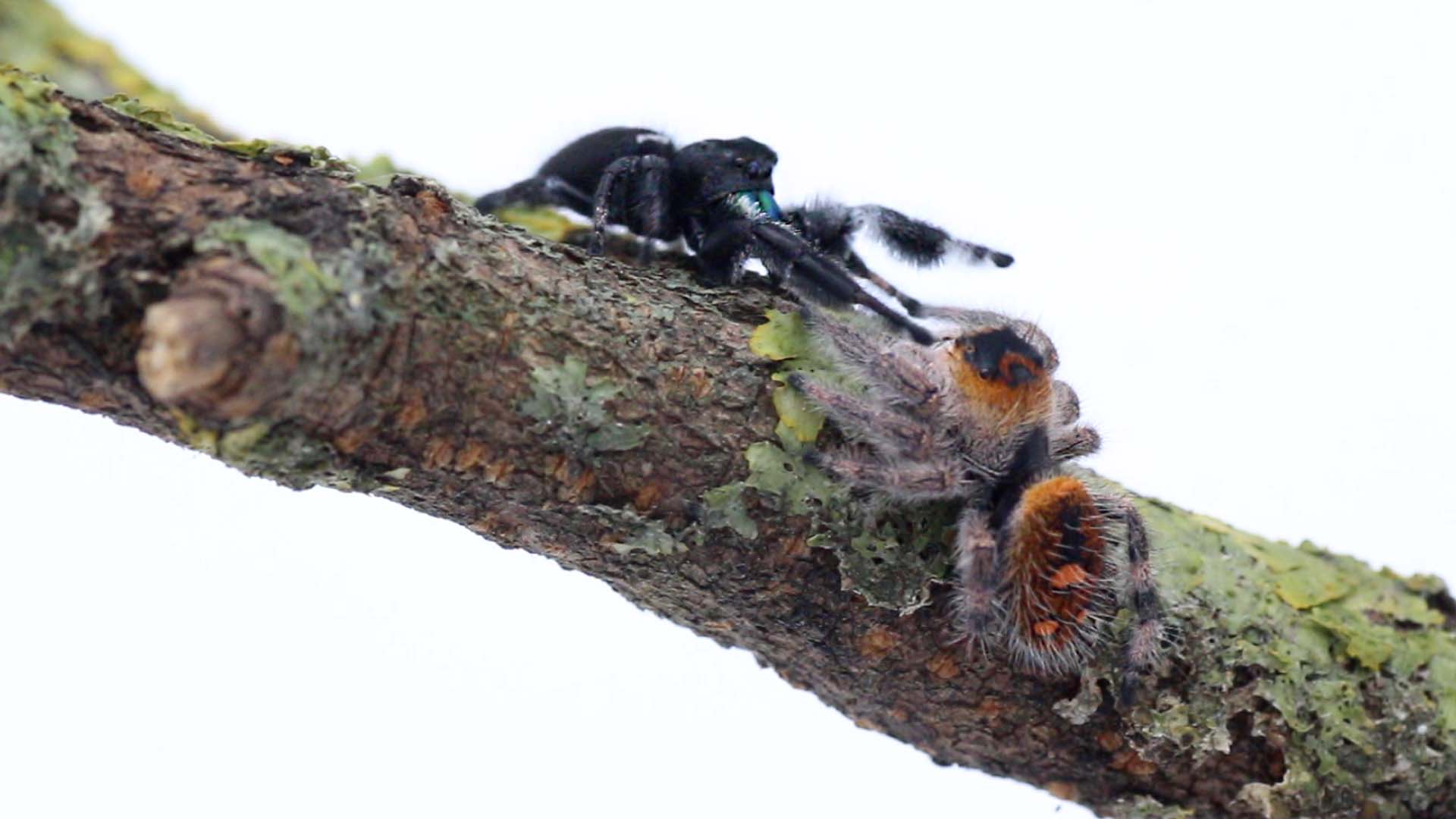


If you are interested in breeding jumping spiders, the question soon arises as to how to go about mating them correctly. As is widely known, male jumping spiders enter unsafe territory as soon as they sit opposite the female. If the female is not sufficiently nourished, it could well happen that her lover ends up as dessert. Before the actual jumping spider mating can take place, however, various points must be clarified. What exactly that is, follows now!
Breeding requirements and ethics
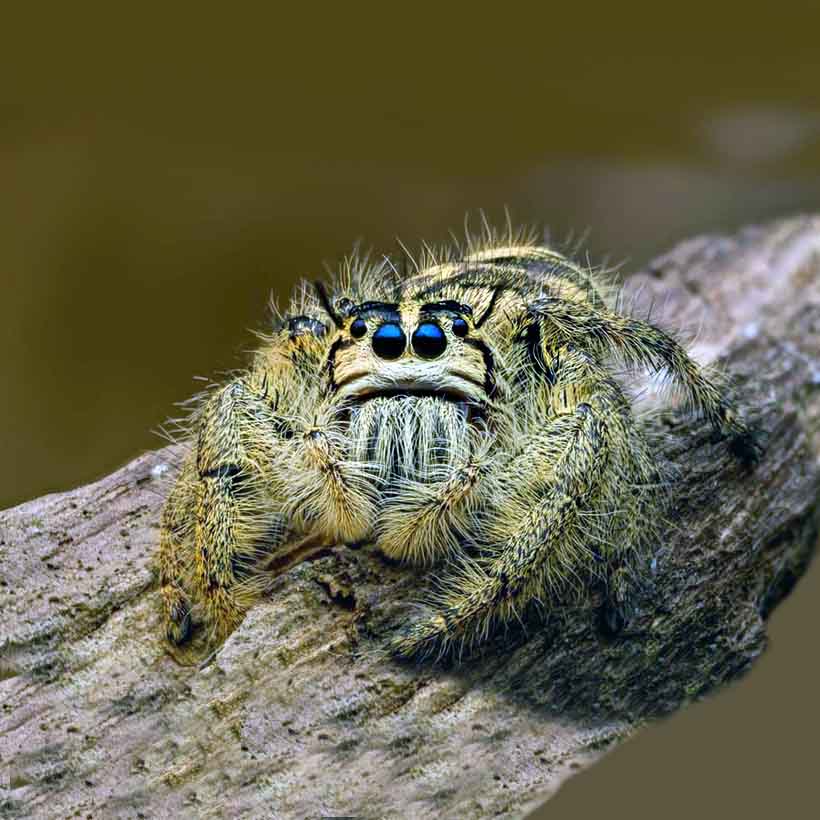
To breed jumping spiders, you first need a female and a male specimen of the species of jumping spider you want to breed. The article on sexing jumping spiders can help you to find out whether you have a male and a female at home. Crossbreeding with different jumping spider species such as Hyllus diardi, Phidippus audax or Phidippus comatus is often genetically impossible. For one thing, they are not compatible with each other and mating attempts in this direction should be avoided. These mating attempts usually end with one animal being eaten and if not, the resulting offspring are often not capable of mating. Mating different Phidippus regius local forms such as Phidippus regius “Apalachicola” and Phidippus regius “Everglades” should also be avoided, even if it is theoretically possible.
The mixing of different species and local forms is called hybridization. Hybrids are not well regarded in the terrarium hobby and sell poorly. In addition, hybridization is irreversible and ultimately results in the loss of the diversity of species, colour variants and local forms that are only available to a limited extent in the terrarium hobby anyway. For this reason, you should stick to mating a species or local form only among themselves.
How can I tell that my jumping spiders are ready to mate?
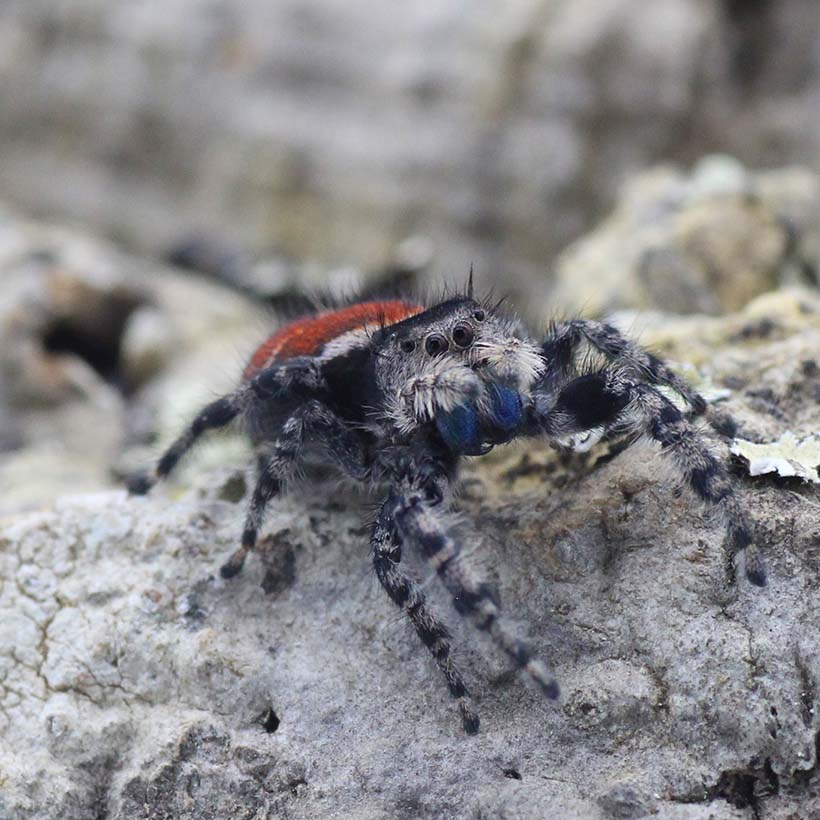
Before jumping spiders mate, it is very important to clarify whether your jumping spiders are ready to mate at all. Your jumping spider is ready to mate as soon as it is an adult, i.e. as soon as it has completed its last moult and all sexual characteristics are fully developed. If the bulbs, i.e. the thickenings at the tip of the pedipalps, are clear and defined comma-shaped, your male is an adult and therefore ready to mate.
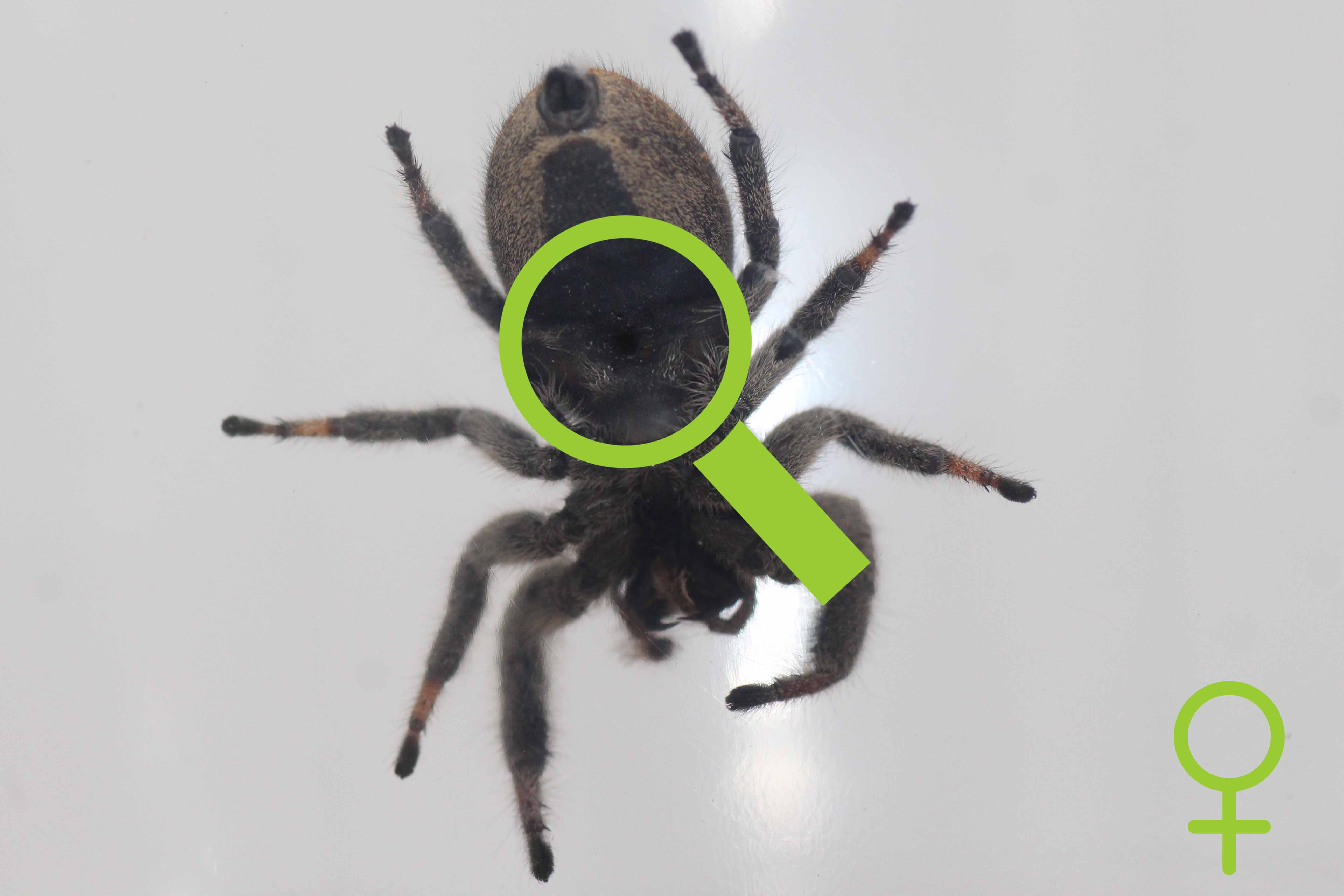
You can find a good example image below. If the thickenings are still rather rice-shaped or oval, your male probably needs one or two more molts. You can recognize the sexual maturity of your female by the fact that her epigyne, the sexual opening between the book lungs on the “abdomen” of your spider, is clearly defined as a black, shiny dot. You can also find a good example picture of this below. In some forums, exact information is given on the number of feeding moults in which the jumping spiders should be sexually mature. This information should not be believed, as the number of moults until sexual maturity within a species is also defined by external influences such as heat and can therefore even differ depending on the individual.

Preparations for jumping spider mating
As soon as your jumping spiders have had their last moult and are adults, you should give them about 1.5-2 weeks before you mate them. This will allow the animals to fully harden. This will also give the male enough time to build a sperm web and charge his bulbs. You should also feed your female regularly and more often than usual during this time. This increases the chance that she will not perceive the male as food.
The day of the jumping spider mating
If your male and female have now been adult for some time and are well fed, nothing stands in the way of the actual jumping spider mating. I recommend feeding the female well again on the day of mating and placing the male with her if she still has food between her fangs.
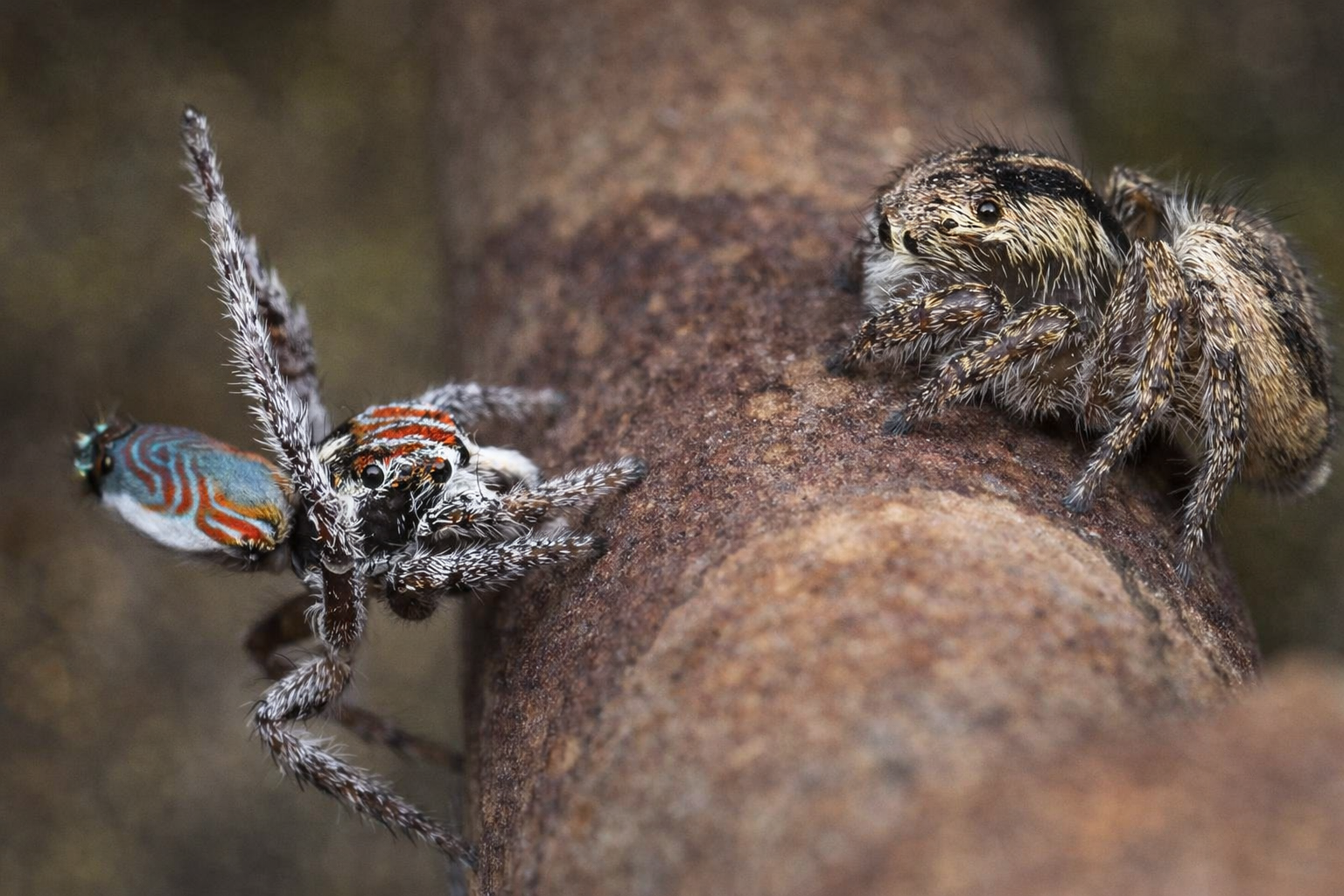
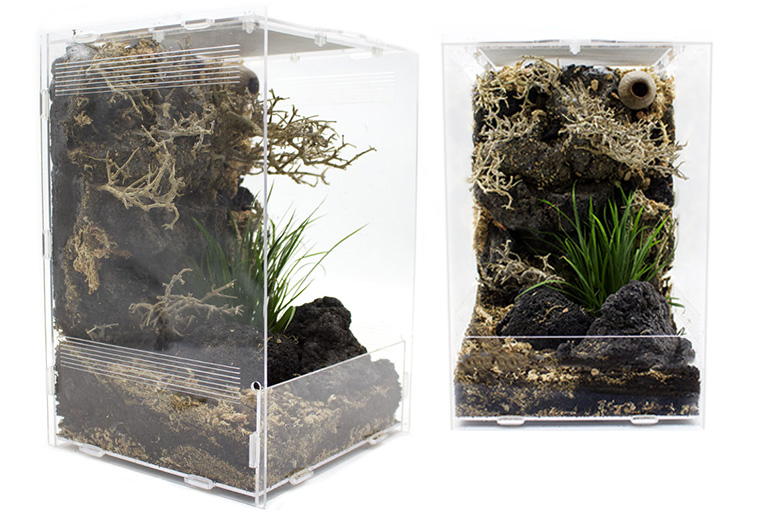
Most of the time she simply continues to eat as long as the male is doing his job. I also recommend putting the male in the female’s terrarium. This way, the male can usually quickly detect the female’s pheromones and find her more quickly. The mating act takes place in such a way that the male performs a kind of mating dance in front of the female for some time with his front legs raised and then climbs onto her back.
In doing so, it turns its opisthosoma, i.e. its rear end, around and pumps its sperm into the female’s epigyne with the bulbs. If you look closely, the pumping can also be observed very clearly.
This mating act can take different lengths of time, e.g. 5-45 minutes or even longer. However, success does not depend on the duration of the mating. If the female is well fed, the mating is peaceful in 8 out of 10 cases and the two go their separate ways without incident. As soon as a successful mating has been observed and the two animals have separated again on their own, the male can be caught again from the female’s terrarium.
It is not usually necessary to re-mate after some time. After mating, it usually takes 2-4 weeks for the female to lay her eggs. Then another 4-6 weeks until the babies hatch and leave the nest. Furthermore, it is likely that your female will not just build a cocoon. After mating once, females can lay fertilized eggs one to five times.
Mating jumping spiders is an exciting and delicate moment for us onlookers and for the jumping spiders themselves. However, if you follow the suggested tips, a successful outcome is almost guaranteed.
If you have any further questions, please leave them in the comments below the article.
Leave a Reply
You must be logged in to post a comment.