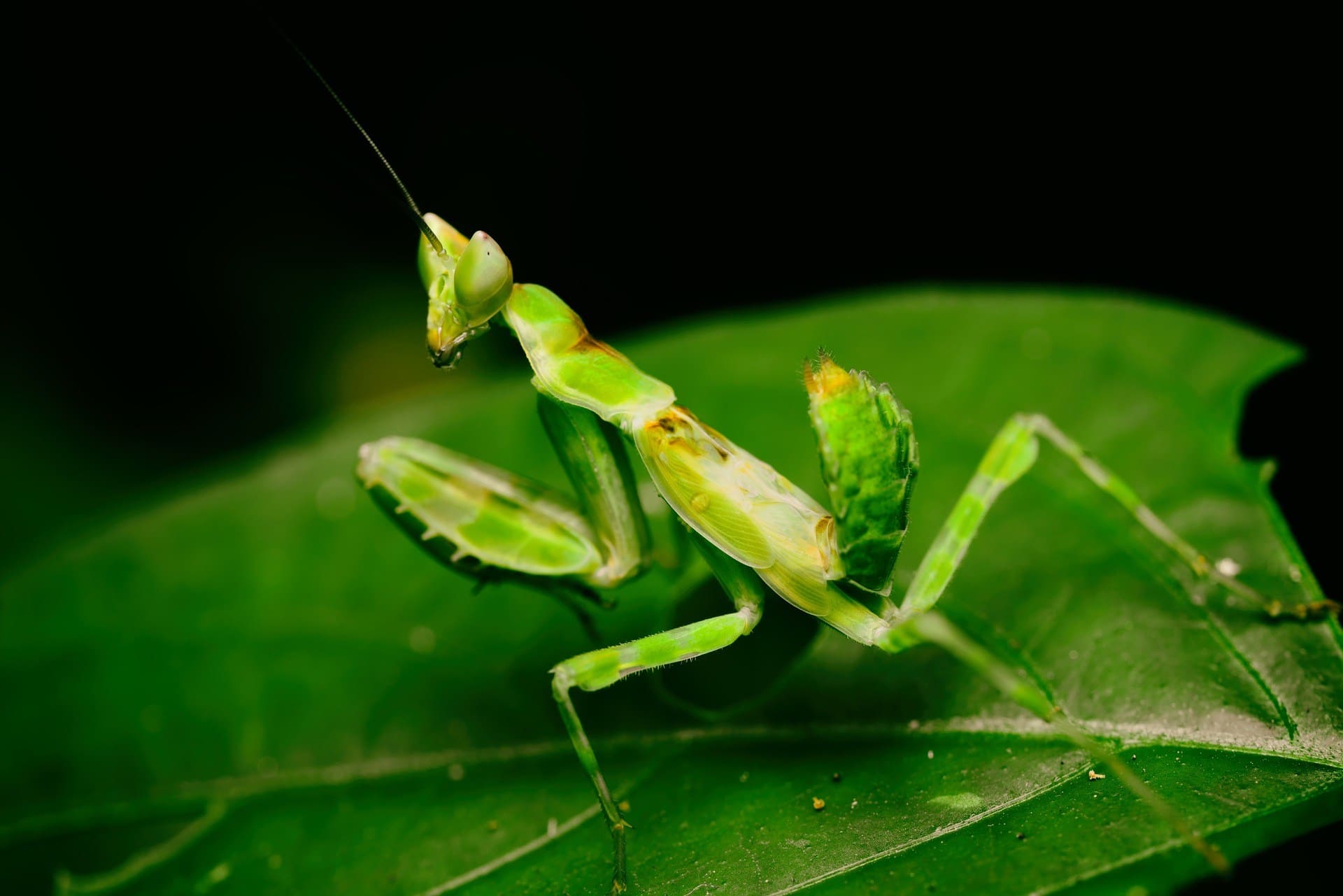


Praying mantises are fascinating creatures and are widespread throughout the world. They are also very easy to keep at home. Even people who don’t usually care much for insects can easily be won over by the fascination of the praying mantis when they turn their head and look at you over their shoulder (that’s right, they’re the only insect species that can do that!) Praying mantises come in many different colors, from pink like an orchid mantis to white. However, most are brown or green. Praying mantises are quite easy to raise, a lot of fun and you will certainly learn a lot about these unique and exciting insects simply by observing their daily antics.
Systematics
The systematics (ancient Greek: ordered) of living organisms, also known as biosystematics. Classical systematics is mainly concerned with the classification, naming and identification of living organisms. Systematics also includes the reconstruction of the phylogeny of organisms and research into the processes that lead to the diversity of organisms (theory of evolution).
The mantids belong to the subphylum of the
- Tracheal animals (Tracheata)
The group owes its name tracheal animals to a very important feature for terrestrial life. They have a system of so-called tracheae. These are air ducts that run through the body and supply all cells with oxygen and in some places lead to the outside through so-called stigmata, i.e. an opening in the tracheal system.
A further adaptation to life on land was the reduction to one pair of antennae in contrast to the crustaceans. This corresponds to the first pair of antennae of crustaceans and thus the trachea animals can be easily classified.
In simple terms, we can already say the following about mantids:
– They do not breathe through the nose or mouth but through tracheas
– They have a pair of antennae

(Here as an example of a tracheal animal a silverfish. I use them to incubate my phasmid eggs as very reliable mold killers)
The mantids belong to the superclass of
- Hexapod
The main characteristic of the hexapods is that their bodies have a fixed number of segments. The head, for example, consists of six fused segments, which can be recognized by the head limbs and, above all, the nerve nodes in the head area. As we already know, the head has a pair of antennae and three pairs of mouthparts, known as mandibles, maxillae and labium. The labium corresponds to the 2nd maxillae of crustaceans and millipedes; it most probably originated from a fusion of the paired 3rd mouth extremities.
The thoracic region (lat. thorax) always consists of three segments, each of which carries a pair of walking legs (making a total of three pairs of walking legs and six walking legs) and thus gave this group its name. In the flying insects (Pterygota), the last two thoracic segments carry the wings.
The abdomen consists of 11 segments plus a so-called telson. The telson is the last part of the body that carries the anus. These segments can be partially fused in the different groups within the hexapods.
Further characteristics of the hexapods are the tail appendages, consisting of two cerci, which are the paired abdominal appendages on the last abdominal segment, and a terminal filum, which is the third filament in the middle. In addition, hexapods have compound eyes and punctate eyes in their basic structure and, of course, the tracheal system already mentioned.
To summarize, we now know the following about mantids:
– They do not breathe through the nose or mouth but through tracheae
– They have a pair of antennae
–They have three pairs of mouthparts (mandibles, maxillae and labium)
– The thorax consists of three segments on which there are six legs
– They have three tail appendages

(Springtails belong to the group of hexapods. They are the perfect waste recyclers in any terrarium substrate)
The mantids belong to the class of
- Insects
Insects are the most species-rich class of animals of all. Around one million insect species have been scientifically described to date. This means that more than 60 percent of all described animal species are insects.
If humans were to become extinct, it would have no direct impact on nature. However, if insects were to become extinct, this would have a massive impact on the entire ecosystem.
The outer layer of the insect body is the chitin shell, which contains chitin and several proteins. It is formed by an underlying epidermis. Embedded in it are the sensory organs and various glands of the insect. With greater or lesser involvement of the epidermis, the chitinous shell forms various surface structures, including tubercles, spines, hairs, bristles, scales and bumps. The outer layer of the insect or individual body parts can be colored due to the incorporation of dyes or special light-refracting surfaces.
The main sensory organs are hair sensilla, which are distributed over the body. These react to vibrations and oscillations, but can also perceive odors, moisture or temperatures. Some of these sensory cells are grouped into sensory organs. The compound eyes and ocelli serve as optical sensory organs, and in many larvae also the larval punctate eyes.
The vascular system of insects essentially consists of a cavity, the haemocoel, in which all internal organs swim in blood. This is called an open circulatory system.
With the exception of a few species, all insects are asexual. Very few species are hermaphrodites, a number of species reproduce by parthenogenesis.
To summarize, we now know the following about mantids:
– They do not breathe through the nose or mouth but through tracheae
– They have a pair of antennae
– They have three pairs of mouthparts (mandibles, maxillae and labium)
– The thorax consists of three segments on which there are six legs
– They have three tail appendages
–They have a chitinous shell
– The main sensory organs are hair sensillae
– They have an open bloodstream
– Mantids are asexual

(Desert locusts are insects and are excellent food for mantids)
The mantids belong to the subclass of
- Flying insects
All insects (Insecta) that are equipped with wings are summarized as flying insects (Pterygota). This includes those species that have lost the ability to fly in the course of evolution. The wings are a thin chitinous plate with tracheae running through it. They probably developed from a flattening of the lateral plates (paranota) on all three thoracic segments (thorax). However, flying insects living today only have two pairs of wings, one on the second and one on the third thoracic segment.
To summarize, we now know the following about mantids:
– They do not breathe through the nose or mouth but through tracheae
– They have a pair of antennae
– They have three pairs of mouthparts (mandibles, maxillae and labium)
– The thorax consists of three segments on which there are six legs
– They have three tail appendages
– They have a chitinous shell
– The main sensory organs are hair sensillae
– They have an open blood circulation
– Mantids are asexual
–They have two pairs of wings

(Drosophilas belong to the flying insects and serve as food animals for mantids at the beginning of their lives)
The mantids belong to the superorder of
- New wings
A special joint and the corresponding musculature serve as the defining characteristic of the Neoptera. With the help of this joint, they can fold their wings backwards onto their abdomen.
The ability to fold their wings close to their bodies enables the animals to colonize a whole range of habitats. This change enables them to hide and penetrate narrow burrows and cracks. With the modification of the joint and the flight musculature, the wing itself also had to be redesigned so that it could be folded in. This was done via a series of grooves in the wing.
To summarize, we now know the following about mantids:
– They do not breathe through the nose or mouth but through tracheae
– They have a pair of antennae
– They have three pairs of mouthparts (mandibles, maxillae and labium)
– The thorax consists of three segments on which there are six legs
– They have three tail appendages
– They have a chitinous shell
– The main sensory organs are hair sensillae
– They have an open blood circulation
– Mantids are asexual
–They have two pairs of wings
–Their wings lie close to the body
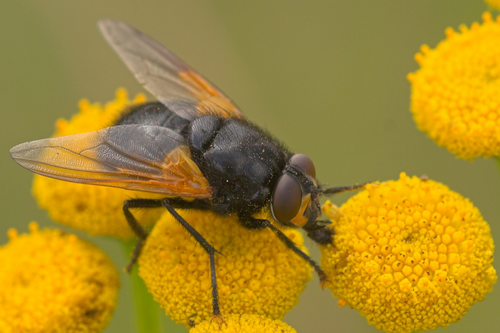
(To enhance the value of houseflies as food, they can be dusted with Korvimin ZVT beforehand)
Mantids belong to the order of
- Mantis
The mantis shrimp owe their unusual appearance for insects not only to the transformation of the first pair of legs into muzzle legs, but above all to an extension of the first thoracic segment, which greatly extends the radius of action of the muzzle legs. The triangular head of the animals is connected to the prothorax via the neck. Unlike almost all other insects, the head of the praying mantis can be rotated over a large angle. This transformation of the thorax with the ability to rotate the head is otherwise only found in camel-necked flies and mantis shrimps, which belong to the net-winged insects.
The mantis shrimp’s tentacles are formed from the lower leg and the upper leg. The lower leg (tibia) has many spines and a large end claw. It can be folded against the thorny femur like a pocket knife. The hip limbs are also elongated and freely movable. With these tentacles, the mantis shrimp can strike within 0.1 seconds to catch a victim. Many species can even catch flies from the air with this precise catching apparatus. In a lurking position, the mantis legs are raised and held against the body, which is why the animals were given the name praying mantis.
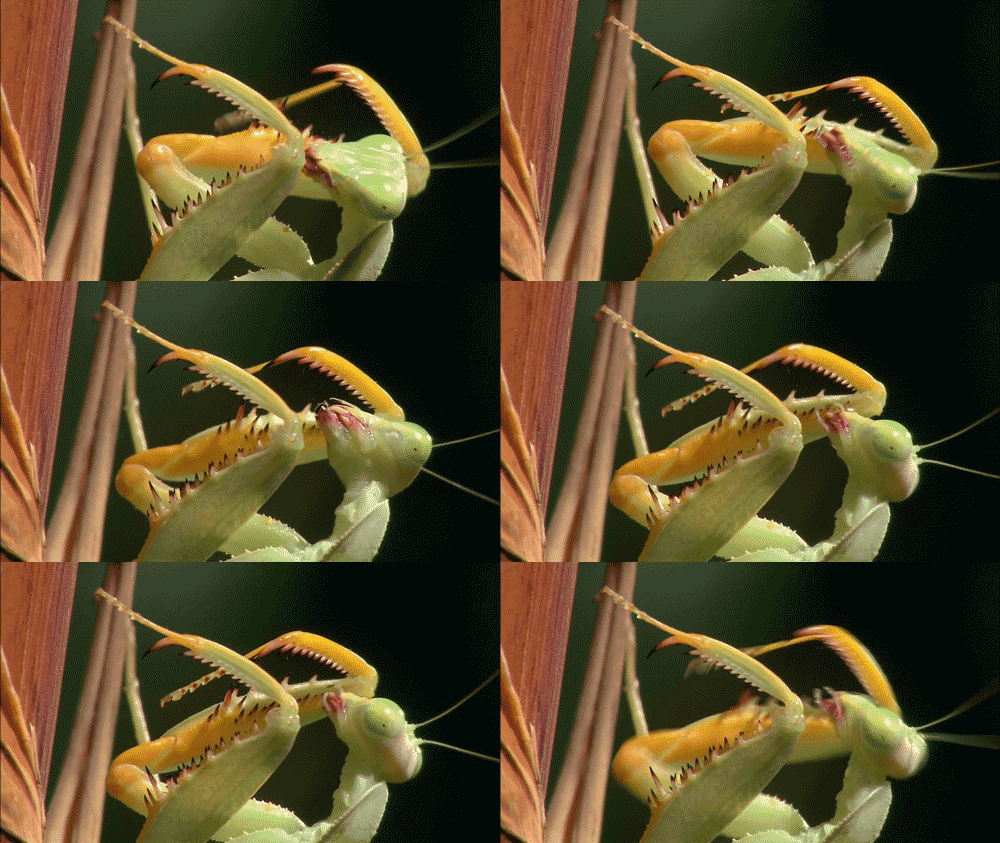
The animals’ large compound eyes are widely spaced, enabling stereocopic vision. As they are used to locate and track prey and to precisely locate sexual partners, they are the animals’ most important sensory organ. Another sensory organ is the unpaired auditory organ between the rumps of some species. This can be used to hear sounds in the range of 25 to 130 kHz and is presumably used to locate bats in flight. The so-called auditory cleft lies between the 2nd and 3rd pair of legs and is only 0.2 mm wide. Females have less hearing than males. Some species also have two hearing organs arranged one below the other, which can perceive different frequencies. Other species have no hearing organ at all.
To summarize, we now know the following about mantids:
– They do not breathe through the nose or mouth but through the trachea
– You have a pair of antennas
– They have three pairs of mouthparts (mandibles, maxillae and labium)
– The thorax consists of three segments on which there are six legs
– They have three tail appendages
– They have a chitinous shell
– The main sensory organs are hair sensillae
– You have an open blood circulation
– Mantids are asexual
– They have two pairs of wings
– Their wings lie close to their body
– They use their tentacles to kill their prey
– They can turn their triangular head over a large angle
– They can see stereoscopically with their compound eyes
– They have an unpaired auditory organ between the hind hips
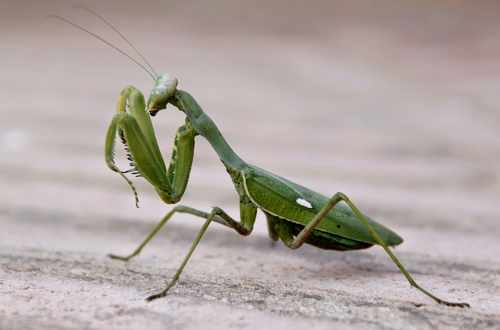
(Mantis religiosa, the only mantis species living in Germany)