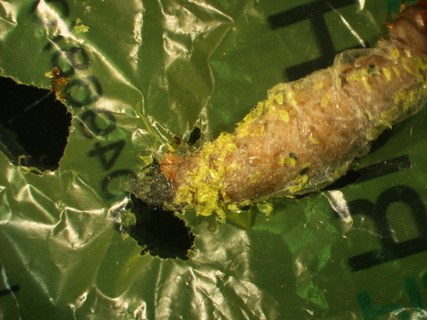


Who doesn’t know them, the chocolate bars for reptiles? Wax moth caterpillars (Galleria mellonella) are very popular with our animals and we have to feed them carefully as they have a very high fat content.
Anyone who has some at home also knows that you can’t keep them in thin-walled plastic tins for too long, otherwise they will eat through quite quickly.
Ergo what is the result? You transfer it to another vessel?
No! You take it to the nearest university and tell them about a miracle caterpillar that eats large quantities of plastic and the sensation is perfect.
A piece of news went around the world this week. A hobby beekeeper, while disposing of the caterpillars she had as unwanted guests in her beehive, noticed that they ate their way through the waste bag very quickly. With this discovery, she went to the Universidad de Cantabria in Spain, where they found out that around 100 wax moth larvae can eat around 92 milligrams of a normal shopping bag in twelve hours. That’s ridiculously little? No, it’s faster than anything that has ever been scientifically published on this subject!
They suspect that a molecule or enzyme, which they are now trying to isolate, is responsible for this rapid decomposition. This enzyme could then be produced on a large scale and used to break down plastic waste.
For me personally, this news was a sign to look at things from different angles. What is a sensation for other areas was a disadvantage for me that had to be solved. Looking back, I could kick myself in the ass. As is so often the case, you’re always smarter afterwards and think to yourself, why didn’t I think of it myself and publish this discovery? But it doesn’t help, in future I will try to look at anomalies not just pragmatically, but also think about the bigger picture.
Did you like the article?
Like Insektenliebe on Facebook!

Leave a Reply
You must be logged in to post a comment.