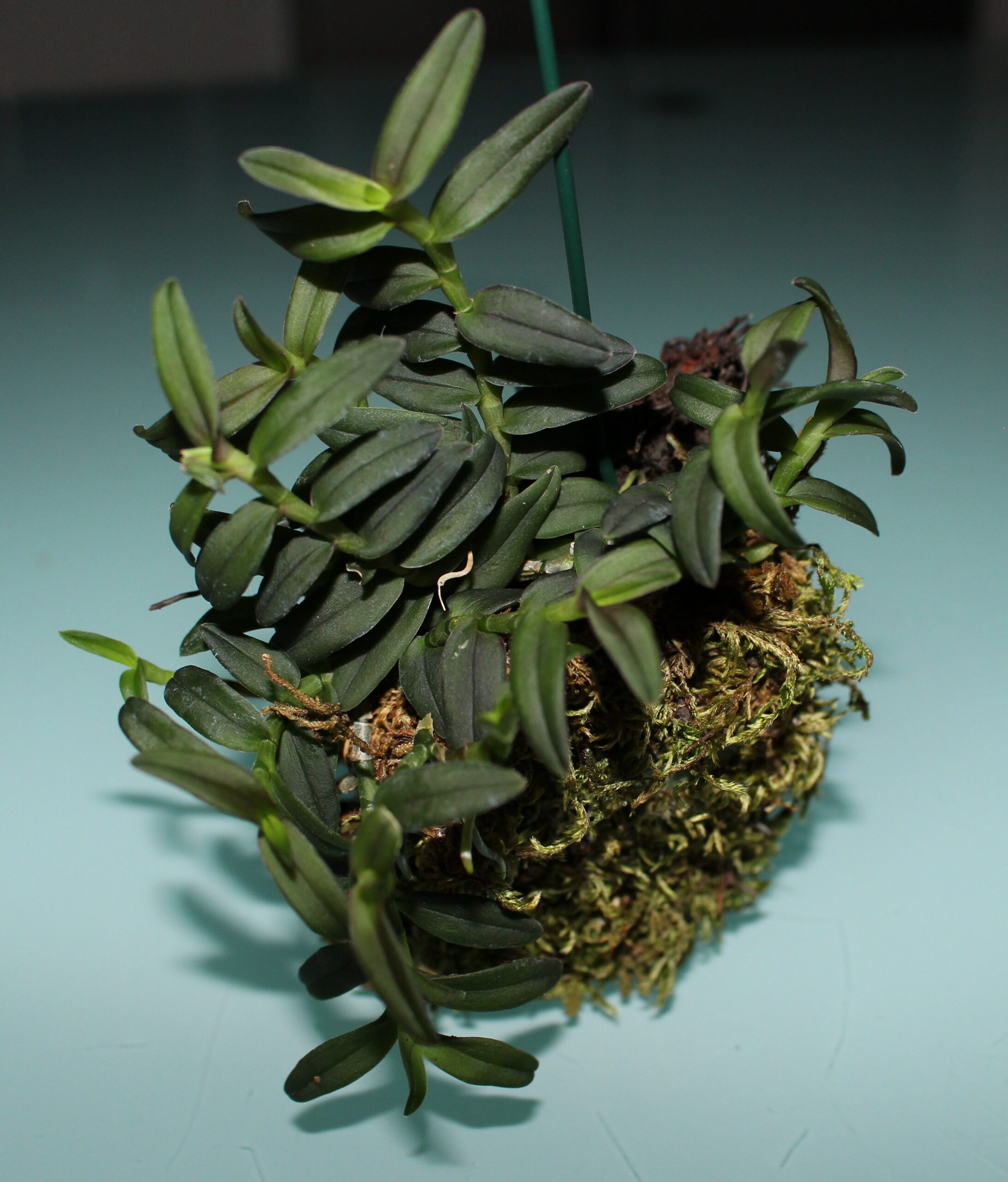


In my lastblog post, I talked about the advantages of real plants in the terrarium and introduced my new orchids. Now I want to tie up the orchids and hang them in my BraPlast tins.
Generally speaking, orchids kept indoors are more care-intensive, as the humidity in the potting substrate can be maintained better than in the room. For this reason, you should spray or shower orchids in the room several times a day.
The humidity in the terrarium is higher, so this disadvantage is not relevant. On the contrary, in this case a mounted orchid has several advantages:
Which orchids are suitable?
There are different growth forms of orchids and a distinction must be made between:
- epiphytic, growing on other plants
- terrestrial, growing on the earth
- lithophytic, growing on rocks or stones
Therefore, only the epiphytic orchid species is suitable for tying up.
General information about epiphytic orchids
The word “epiphytic” comes from the Greek and means: “epi” = “over” and “phytos” = “plant”; so literally translated “overplant”. This indicates that the plant grows as an epiphyte on other plants. In the past, these orchids were erroneously referred to as “parasites” because it was assumed that they fed on the hosts on which they grew.
These orchid species have been displaced on the ground by other stronger growing plants and have therefore adapted to the habitat on the trees. Only there could they survive with sufficient light and moisture.
Epiphytic orchids feed exclusively through their roots from precipitation, dead leaves, algae, moss, animal excrement, dead animals and so on. They merely cling to their host with their aerial roots in order to have sufficient support. These aerial roots have special properties: they form a multi-layered, so-called velamen radicum.
When dry, the velamen radicum is a white or silvery shimmering cell layer that is able to absorb moisture from the air through numerous large pores. Together with the moisture from the atmosphere, the orchid roots also absorb the nutrients dissolved in it. Many orchids also produce chlorophyll in their aerial roots and can therefore metabolize like green leaves.
Preparation
You will need the following utensils to tie up an orchid:
a piece of cork
- Sphagnum moss
- Tights
- Scissors
- Pliers
- Garden wire
- Binding wire
- an epiphytic orchid
Tie on an orchid
Before I remove the plant from the pot, I give it a half-hour water bath. This makes the aerial roots more elastic and prevents them from breaking off when they are tied up.
In the meantime, you can drill two holes in the support, in my case a piece of cork, one at the top and one at the bottom and pull a piece of wire through. This is where I will hang the orchid later. I make the holes with a small screwdriver and don’t use a machine with this soft material.
Cork is not the only suitable substrate. Sometimes I also use Xaxim. These are dried tree fern trunks. There are lots of seeds and spores of living plants, mainly mosses and ferns, in the numerous cracks, holes and gaps. I always make sure that the Xaxim comes from plantations and not from the rainforest. I will write about why I pay attention to this in another article.
I then lay some sphagnum moss on the cork bark and tie it down with garden wire. When choosing the wire, it is important to make sure that it does not start to rust later. Of course, you can also use other types of moss. I can recommend tree moss from nature, but of course only from trees that have already been felled. You can read about how I use materials from nature here.
Then I cut three 5 mm strips from the ladies’ stockings. You don’t need a ruler for this, just cut them down pi by thumbs. I use these to tie on the orchid. The nylon stockings are ideal as they are elastic, stable and waterproof. This means that the aerial roots are not damaged and can continue to grow unhindered. A little tip: I don’t buy nylon tights for this but ask for free trial stockings in a specialist shoe store. Alternatively, you can also use a waistband elastic, but these have sharp edges and are therefore less suitable.
I tie the orchid so tightly that it doesn’t wobble. As soon as new roots form, they will attach themselves to the support. When this happens in sufficient numbers, you can remove the nylon strips again.
Then spray well over a sink and hang in the insectarium. To do this, I use a scalpel to make two holes in the BraPlast can and attach the wire. And now you have a piece of nature in your insectarium. The mantids and orchids get an optimum indoor climate and it simply looks more attractive than the plastic plants available in the shops.
Which plants do you use in your terrariums?

Leave a Reply
You must be logged in to post a comment.