


We have all asked ourselves this question, and not just once. With every new species you keep, this question is briefly worked through in your head and you usually fall back on experience or ask in various forums. It is not uncommon to get very different suggestions and heated discussions ensue.
As a rule, there are two different groups where opinions differ. On the one hand, there are breeders who want to house many animals and therefore have to calculate exactly which praying mantis needs how much space. The next important aspect for them is the handling of the containers, especially when feeding. Everything should be as quick and easy as possible. What the containers look like plays a subordinate role in this case, as the animals are kept in a hobby room and are not intended for display.
On the other hand, we have owners who want to display their animals as exhibits in their homes and are much more concerned with the appearance and visibility of the containers. Handling often takes a back seat.
At the end of the day, we are talking about a praying mantis and it has no demands on the appearance of its terrarium. Our fosterlings have other requirements that we have to meet in order to keep them successfully.
A terrarium must meet the following requirements:
- Enough space
- Adequate ventilation
Terrarium size:
Most praying mantises are ambush hunters and wait almost motionless for their prey. It is therefore not necessary to offer these mantises a huge terrarium. We often put ourselves in the animals’ shoes and think bigger is better, only to discover later with disappointment that the praying mantis doesn’t actually go for walks in the terrarium and usually hangs motionless on the lid. The mantid requires the most space when moulting, as this doubles its length. As not all branches are located directly under the lid and we also have to take the substrate height into account, special attention must be paid to the terrarium height.
I have developed a formula based on my experience and other husbandry reports. Using this rule of thumb, anyone can easily calculate the size of the terrarium themselves:
Terrarium length
3
3 × final size of the adult mantid
×
Terrarium width
3
3 × final size of the adult mantid
×
Terrarium height
4
4 × final size of the adult mantid
Group housing +25% per mantid per side
Example Phyllocrania paradoxa “ghost mantis”
Final size 5 cm
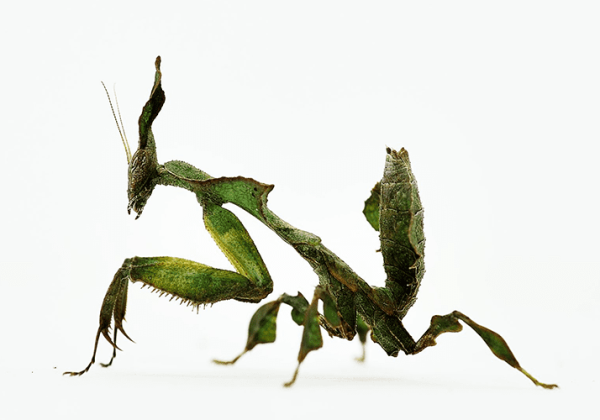
Phyllocrania paradoxa “ghost mantis”
Due to their low aggressiveness, ghost mantids can also be kept together in groups if there is sufficient food available.
Single husbandry
Terrarium length
15 cm
3 × final size 5 cm
×
Terrarium width
15 cm
3 × final size 5 cm
×
Terrarium height
20 cm
4 × final size 5 cm
Group housing
2 pairs of Phyllocrania paradoxa (4 animals)
Terrarium size (single enclosure): 15cm x 15cm x 20cm
4 animals x 25% = 100% (in this case simply double all side lengths)
Terrarium length
30 cm
Size single holding + 4 × 25%
×
Terrarium width
30 cm
Size single holding + 4 × 25%
×
Terrarium height
40 cm
Size single holding + 4 × 25%
Group housing can of course only be used for mantids that are compatible within the species!
Ventilation
One of the really unhealthy factors in the terrarium is stagnant air, which can seriously damage our mantids in the long term. The movement of air in the atmosphere ensures that mantids are unfamiliar with such conditions in their natural environment. In the terrarium, this stagnant air must be prevented by sufficient air circulation, as dangerous germs quickly grow in such an atmosphere in the terrarium. Mould and unpleasant odors can develop, which can be avoided right from the start, i.e. when buying or building the terrarium.

However, very open solutions also cause a lot of heat to be lost in the terrarium, which is why a balance should be struck between economy and necessity, especially in a terrarium where a high heat level is required. The higher the temperature in the terrarium, the better the air exchange with the colder room temperature.
In principle, the terrarium should be surface-dry again within 2 hours after spraying.
Here, too, I have spent a long time comparing, testing and measuring very different terrariums in order to offer a simple solution. Using this rule of thumb, anyone can easily calculate the ventilation of the terrarium themselves:
At least 6% of the floor area should be ventilation area
Example
Terrarium dimensions: 20cm x 20cm x 20cm
Area of one side: 20cm x 20cm= 400 cm²
Area of the terrarium: 400 cm² x 6 sides = 2400 cm²
Ventilation of the terrarium: 2400 cm² x 6%= min. 144 cm²
I myself use prepared plastic tins from the packaging industry, BraPlast tins, screw tins and glass terrariums. As I know how difficult it is to get a well-ventilated terrarium or a perfect screw-top box, I offer both in the store under accessories.
And beautiful doesn’t have to mean impractical. I use drilled holes in my glass terrariums to feed the mantids quickly and without stress. If I’m not there for a few days, I can always install a sprinkler nozzle to ensure the water supply.
Buying a terrarium should therefore be carefully considered beforehand. First of all, I should be clear about which species of mantid I want to buy and with the final size of the mantid I can calculate everything else.
Click here for the video:
Leave a Reply
You must be logged in to post a comment.