


The jumping spider’s visual system is one of the most powerful visual apparatuses in the entire invertebrate kingdom.
What at first glance appears to be a cute detail – the large, forward-facing eyes – is in fact the center of a highly developed perception. Jumping spiders don’t just see well. They see purposefully, selectively and functionally. Their gaze is decisive for hunting, mating and survival.
If you want to understand why jumping spiders dance, communicate and hunt, you first have to understand how they see.
Eight eyes, but no redundancy
Spiders usually have eight eyes. In jumping spiders, however, these are not equivalent. The jumping spider’s visual system is strictly functionally organized. Each pair of eyes fulfills its own task.
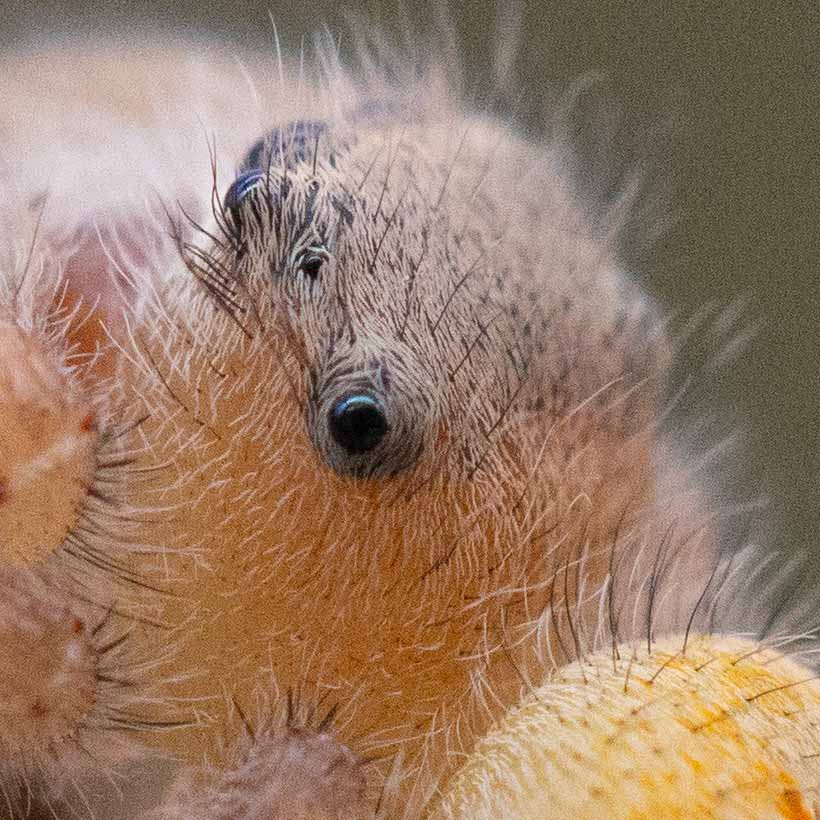
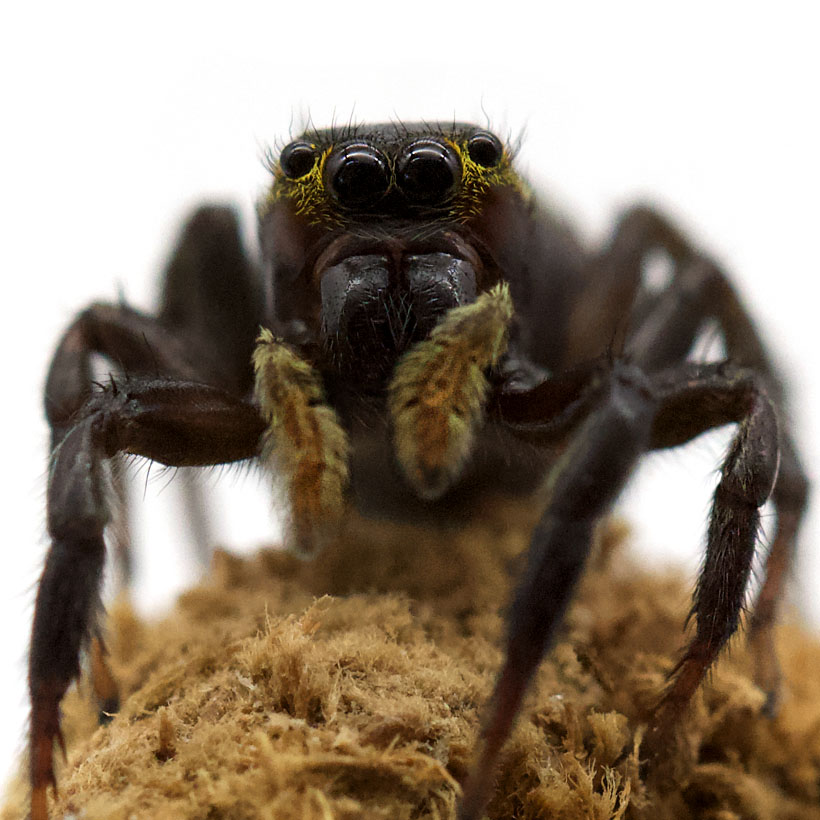
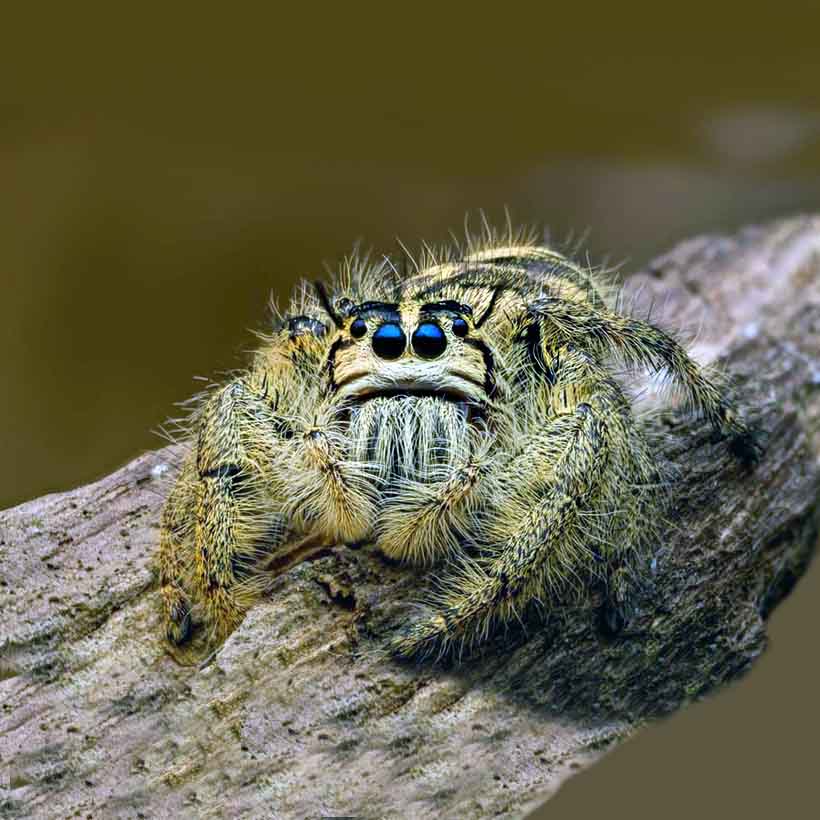
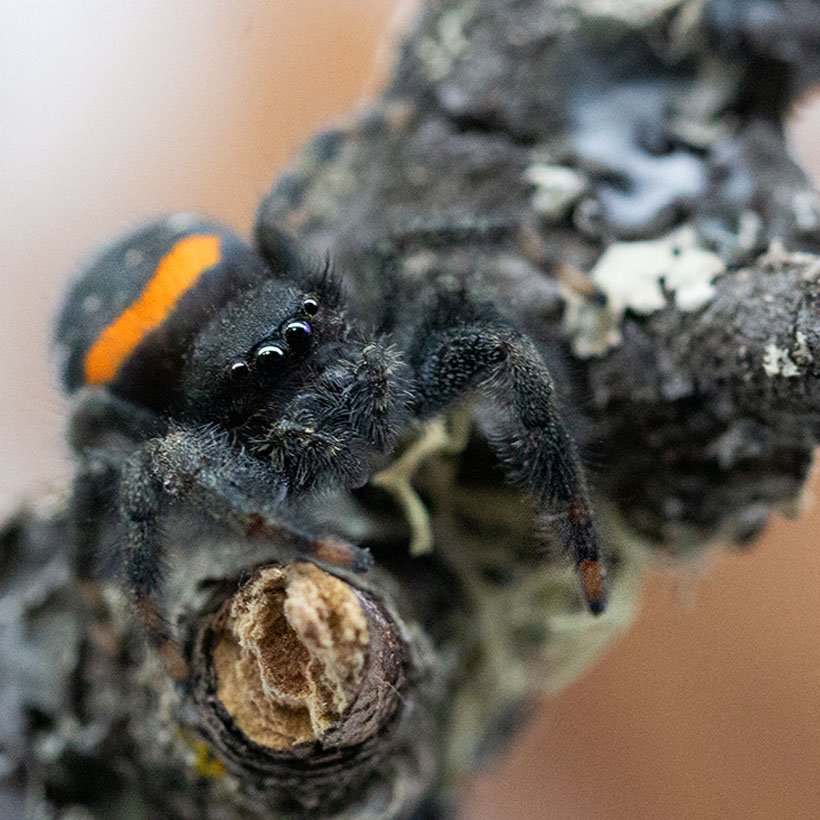
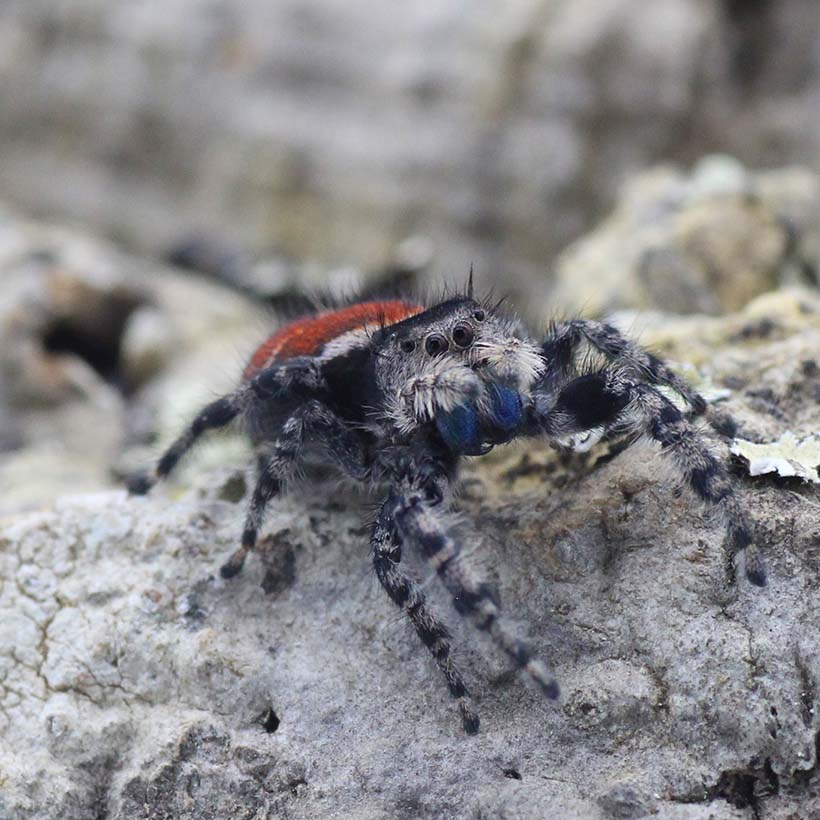
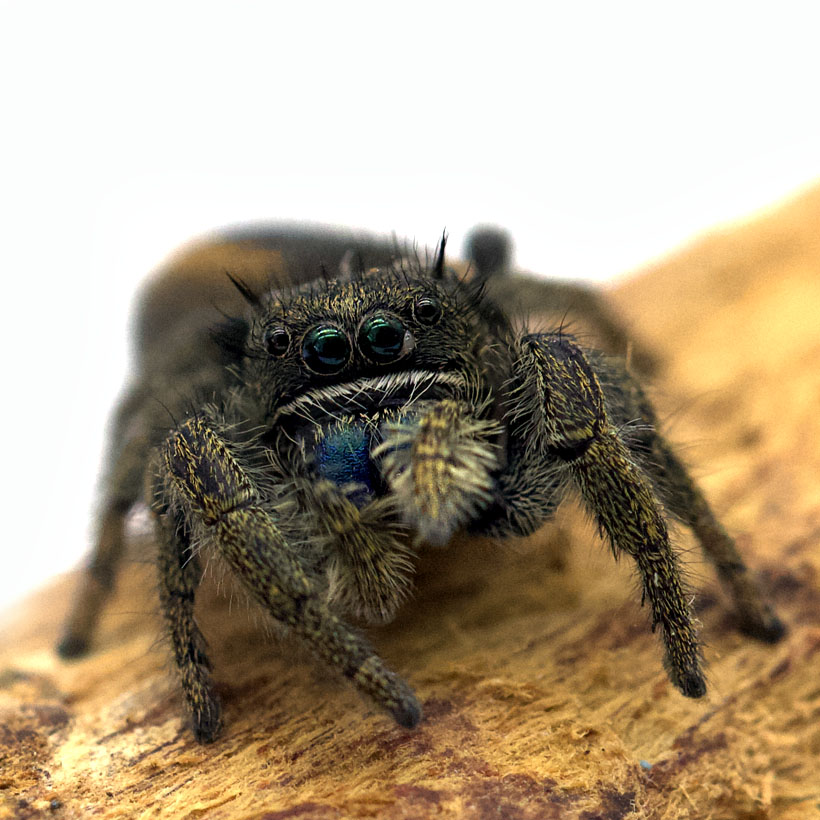
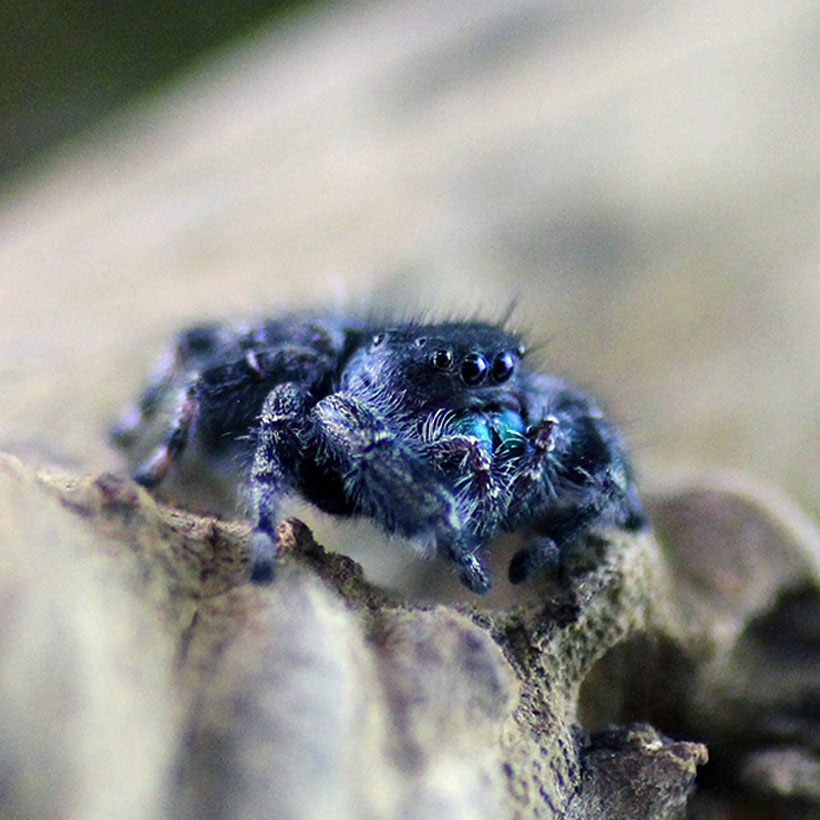
The two large front eyes – the so-called main eyes – provide an extremely high resolution. They have a tubular structure and work in a similar way to telephoto lenses. This allows jumping spiders to recognize details, colors and shapes. Movements, patterns and even fine contrasts can be resolved, even though the animal is only a few millimetres in size.
The other eyes are smaller and differently aligned. They primarily detect movement and changes in brightness in the environment. You can think of them as a permanent early warning system. As soon as something moves, the main pair of eyes is aligned.
The result is not an all-round view, but a dynamic interplay of overview and focus.
Seeing as the basis of hunting
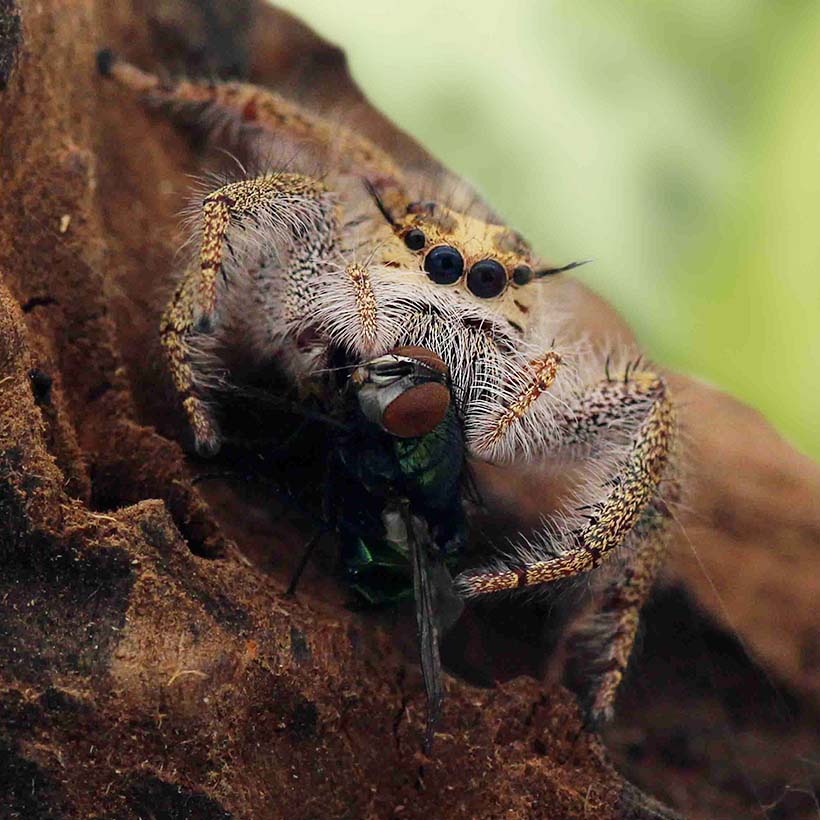
Jumping spiders do not build webs. They actively hunt. The jumping spiders’ visual system is therefore directly linked to their hunting behavior. Prey is recognized from a distance, assessed and targeted.
Jumping spiders calculate distances with astonishing precision. They use minimal movements of their body to gain depth information. Even before they jump, they know whether an attack makes sense.
This clearly distinguishes them from many other spider species. While web spiders react to touch, jumping spiders plan their hunt visually. Here, sight replaces the sense of touch as the primary tool.
Color vision in jumping spiders
A widespread misconception is that spiders only see in black and white. The jumping spider visual system clearly disproves this assumption. Many species have the ability to see in color, at least in the area of the main eyes.
Jumping spiders are particularly good at distinguishing between green and red. This is made possible by special filter structures in the eye that filter out certain wavelengths of light. This solution is evolutionarily unusual, but effective.
Color vision plays an important role in courtship. Striking body parts, shiny hair or high-contrast patterns are only effective if they can be recognized visually. The visual system is therefore not only crucial for hunting, but also for choosing a mate.
Movement before detail
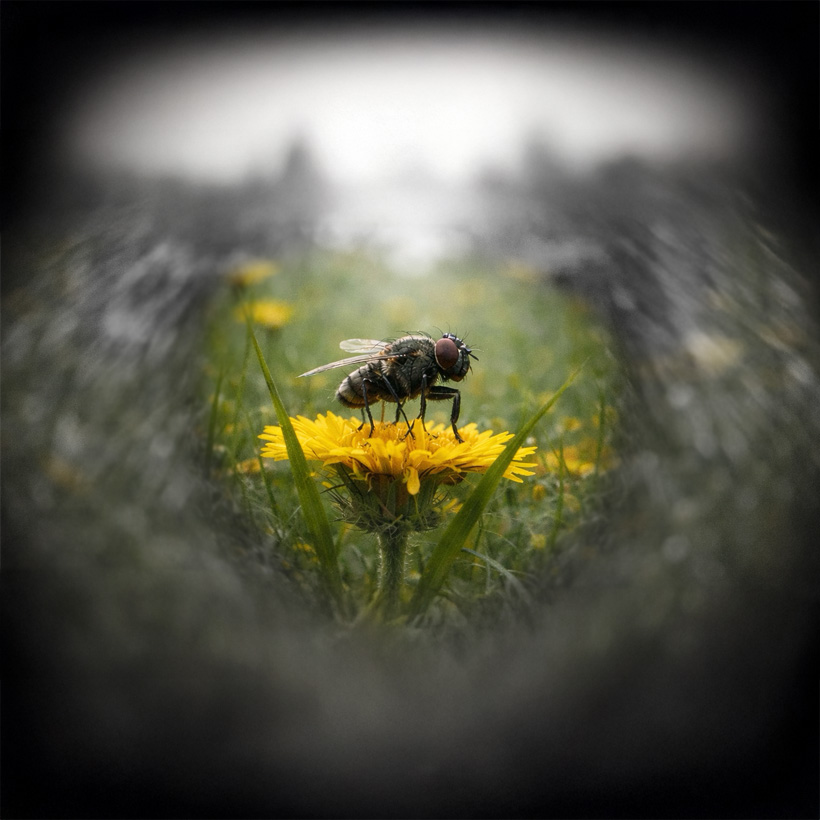
As impressive as the detail resolution of the main eyes is, they only cover a small section of the image. The jumping spider’s visual system therefore prioritizes movement. The lateral pairs of eyes react extremely sensitively to the smallest changes in the environment.
If something moves, the system switches over. The spider aligns its body, fixes the object and then uses the high-resolution front eyes. This sequence takes place in fractions of a second.
For jumping spiders, this means that nothing goes unnoticed for long. At the same time, they don’t waste energy on irrelevant details.
Vision and courtship behavior
The jumping spiders’ visual system is closely linked to their courtship behavior. Dances, leg movements and body postures are precisely coordinated with the visual perception of the female.
It is important to note that color vision and high resolution are only available in the center of the field of vision. This explains why males often try to attract the female’s attention – for example by making sudden movements or striking contrasts.
The dance only works when it is seen. The visual system therefore directly determines the sequence and structure of courtship.
Habitat and visual adaptation
Jumping spiders live in very different habitats. Forests, meadows, rocky landscapes and human settlements have different visual requirements. The jumping spider’s visual system is flexibly adapted to this.
Bright, open areas favor visual hunting. Structurally rich environments with many contrasts facilitate orientation and movement detection. It is therefore no coincidence that jumping spiders often sit in places exposed to the sun – on leaves, walls or window frames.
This relationship is also evident in the terrarium. A structured environment with light and contrasts promotes natural behavior. Pure glass boxes without visual stimuli are not suitable for the visual system.
Misunderstandings about “spider’s eye”
Large eyes quickly lead to anthropomorphization. But the jumping spider’s visual system works differently to the human eye. Jumping spiders do not see sharply all the time. They scan their surroundings selectively.
There is no permanent image of the world, but rather a sequence of targeted perceptions. This makes their behavior efficient, but also difficult to predict. What we interpret as “curiosity” is often simply visual analysis.
Significance for research and understanding
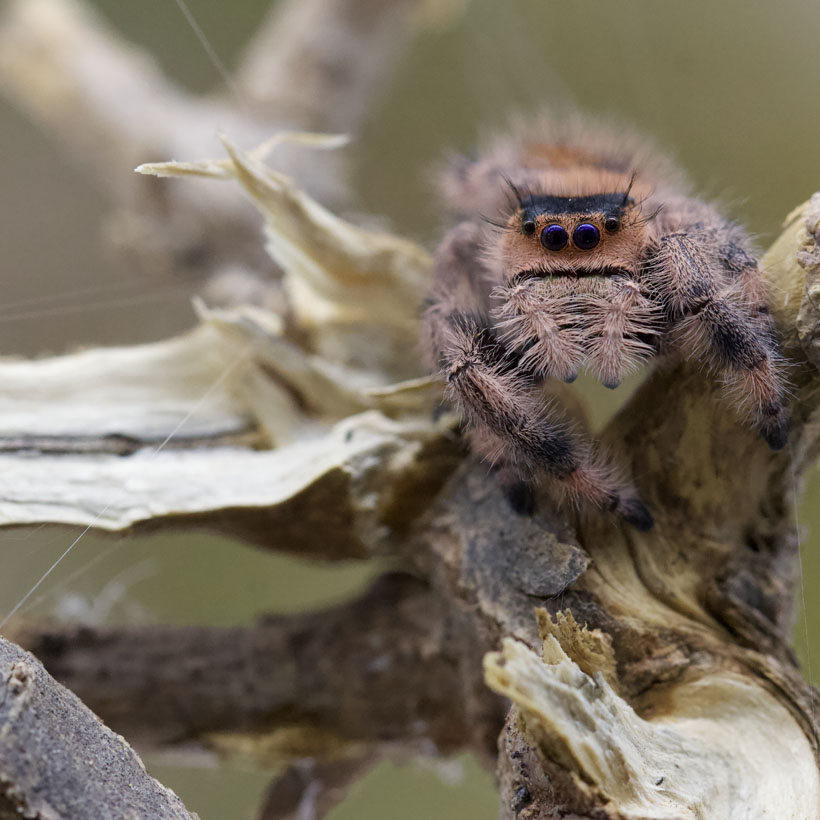
Today, jumping spiders are important model organisms for research into visual perception. Their visual system shows that high performance is not tied to size. They achieve impressive results with minimal neuronal effort.
The jumping spider vision system provides insights for biology, robotics and neuroscience. How can complex decisions be made with limited resources? How does selective attention work? Jumping spiders provide answers.
A look that shapes behavior
The jumping spiders’ visual system is more than just a sensory organ. It is the key to their entire behavior. Hunting, courtship, communication and orientation are all based on it.
When you observe jumping spiders, you see animals that actively capture their environment. Not passively. Not reflexively. But focused, planned and adapted.
Eight eyes are enough to read an astonishingly complex world.
If you have any further questions, please leave them in the comments below the article.
Leave a Reply
You must be logged in to post a comment.