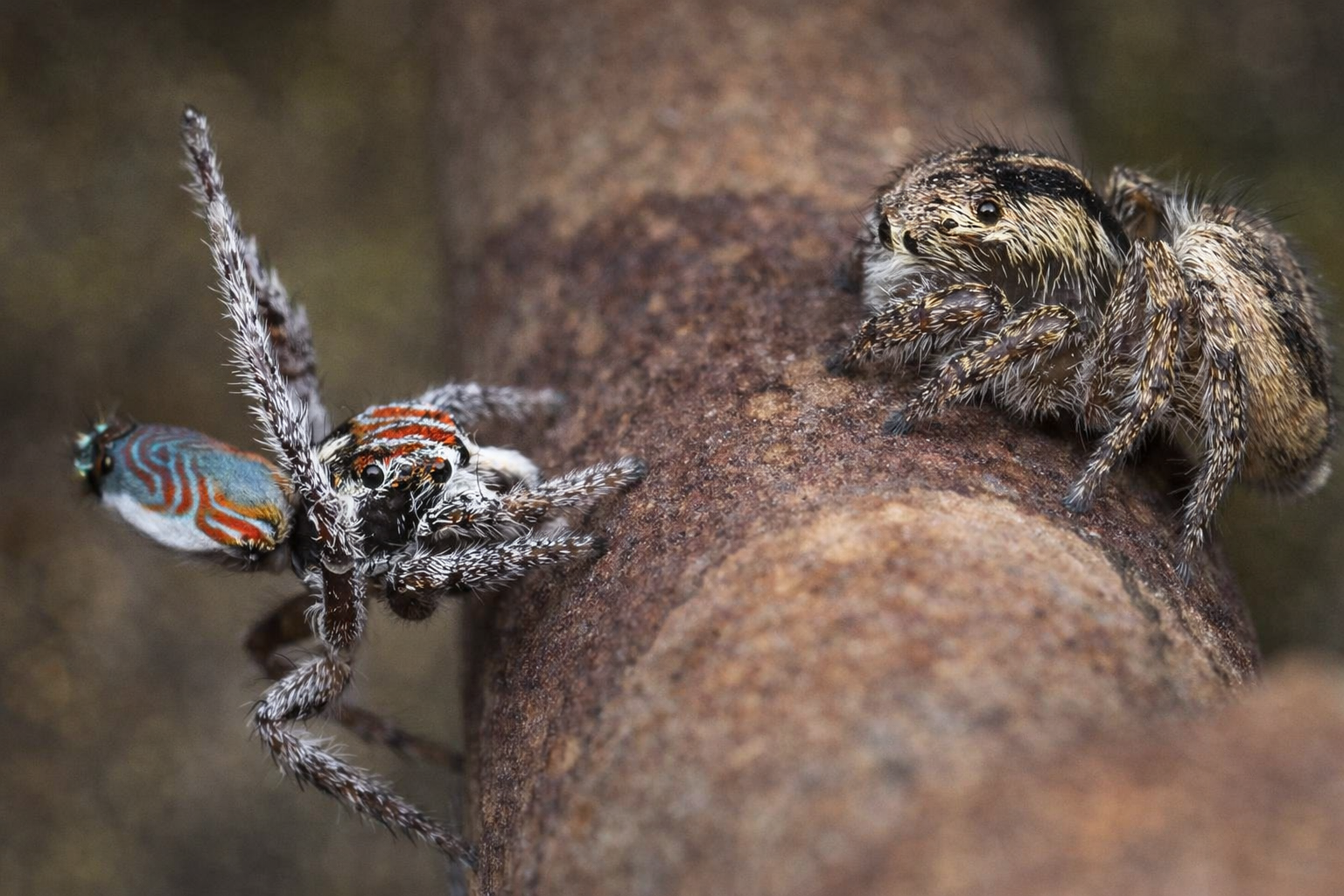


Dancing is life-threatening for a male jumping spider. Every movement decides whether it is allowed to reproduce – or becomes prey itself. No courtship behavior in the animal kingdom is as open, as risky and as precisely coordinated as jumping spider courtship behavior. What appears playful or even cute to us is actually an evolutionary test. Visible. Inevitable. And mercilessly honest.
A jumping spider straightens its body. It raises its front legs. It seems to hesitate briefly. Then it begins to move. Rhythmically. Controlled. With a precision that you would hardly expect from an animal of this size. It is not an improvised twitch, but a predetermined sequence. Every phase has meaning. Every mistake has consequences.
Jumping spiders belong to the Salticidae family. They hunt during the day and rely almost entirely on their eyesight. Unlike many other spiders, they do not build webs. They observe, plan and jump. It is precisely this visual way of life that has given rise to a form of communication that is unique in the invertebrate kingdom. The dance is not an ornament. It is necessary.
Jumping spiders courtship behavior as a high-risk strategy
Spiders are predators. Fast. Reactive. A female jumping spider instinctively distinguishes between prey and conspecifics. For a male, this means that it must clearly communicate in a fraction of a second that it is not food. The dance is the core of jumping spider courtship behavior.
First it signals species affiliation. Then physical fitness. Finally, coordination and stamina. The dance is therefore not a decorative accessory, but a filter mechanism. Only animals in good condition can perform it fully. Weakness cannot be concealed.
In evolutionary terms, this openness makes sense. Every unnecessary approach costs energy. Any mistake can be fatal. Dancing reduces this risk – for both sides.
Movements with a clear function
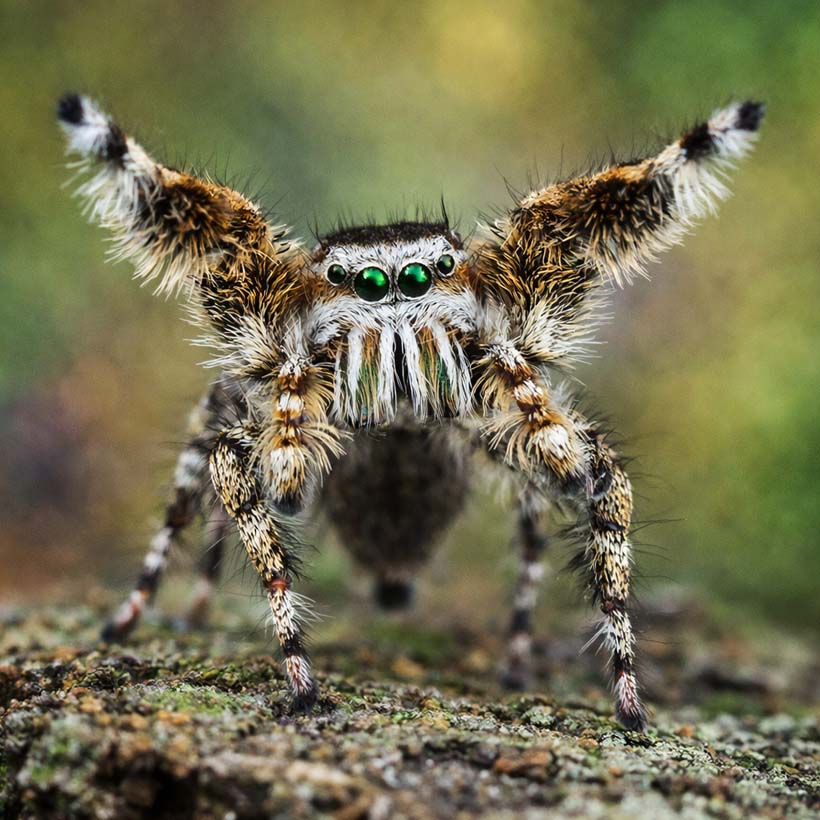
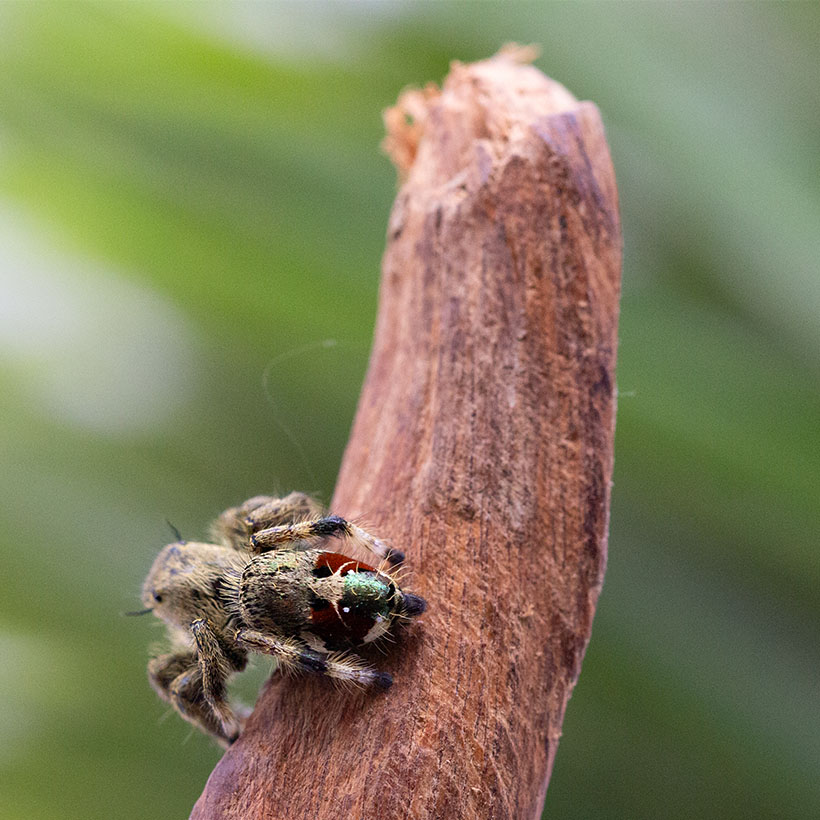
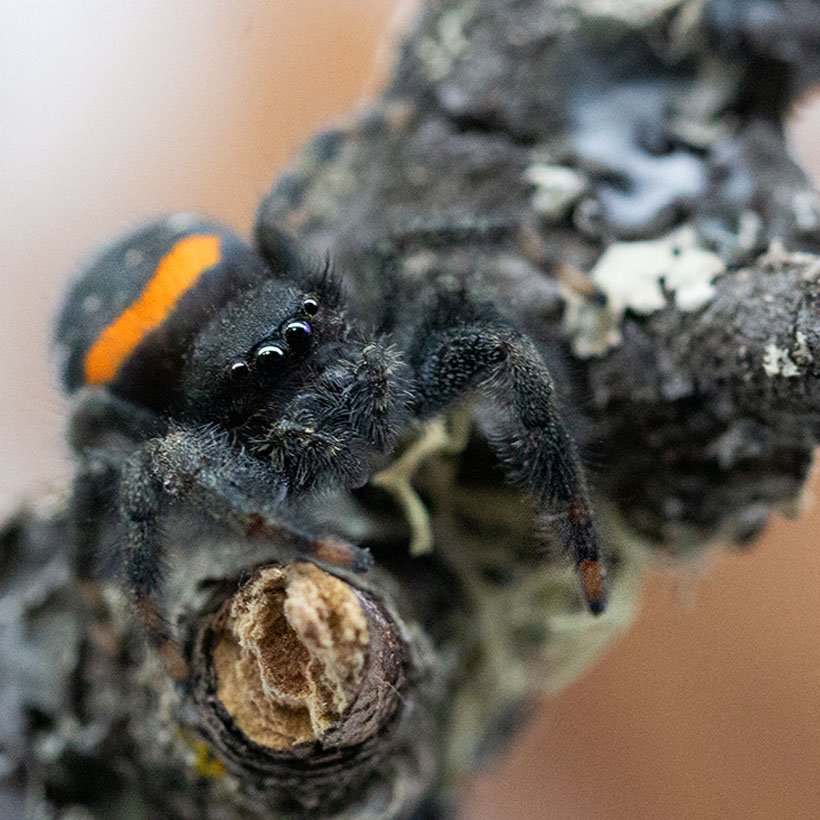
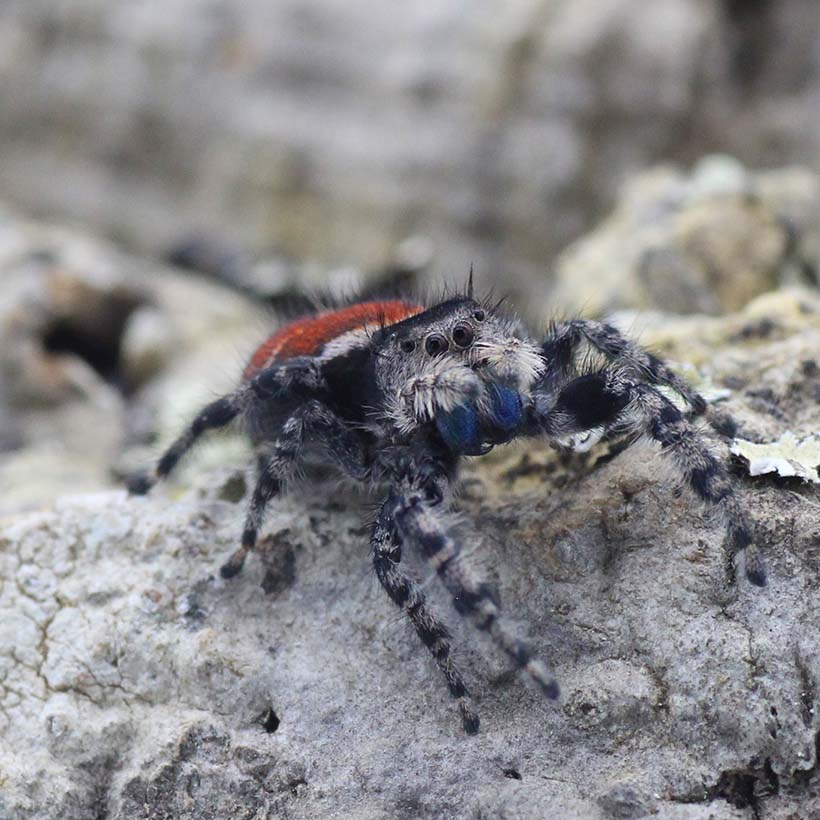
The individual dance movements differ depending on the species. Some jumping spiders only lift one pair of legs. Others present conspicuous pedipalps. Still others show colored knee joints or shiny body parts. The so-called peacock spiders, whose males erect colored abdominal segments and deliberately expose them to light, are particularly well-known.
The decisive factor here is not a single detail. Females react to the overall impression. How even is the process? How long does the male last? Does the rhythm remain stable? Research shows that energy expenditure plays a particularly important role. The dance becomes an honest performance test – a central element in jumping spider courtship behavior.
See and feel at the same time
What distinguishes jumping spiders from many other mating animals is the combination of visual signals and vibrations. While the male dances, it produces fine vibrations that spread across the ground. Wood, stone or earth become the transmission medium.
The female perceives these vibrations via sensory hairs on her legs. It sees the dance – and “hears” it at the same time. Certain movement phases are precisely coupled with certain vibration patterns. This multimodal communication is typical of jumping spiders’ courtship behavior.
This double protection is not a luxury. In natural habitats with changing light, wind movement and visual disturbances, it increases the chance of being understood.
A visual system as a basis
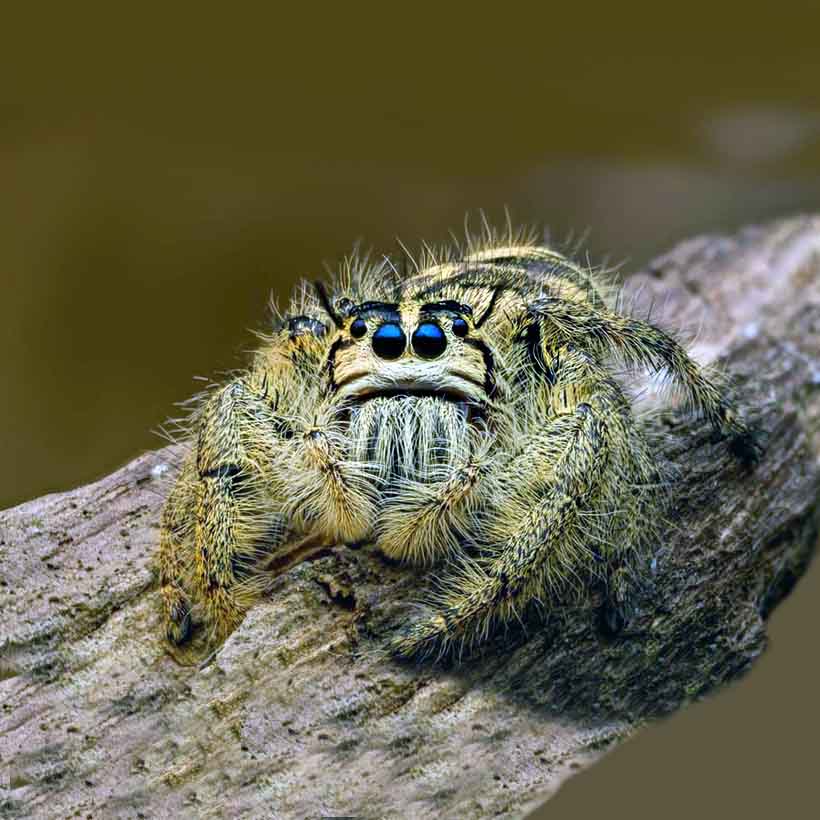
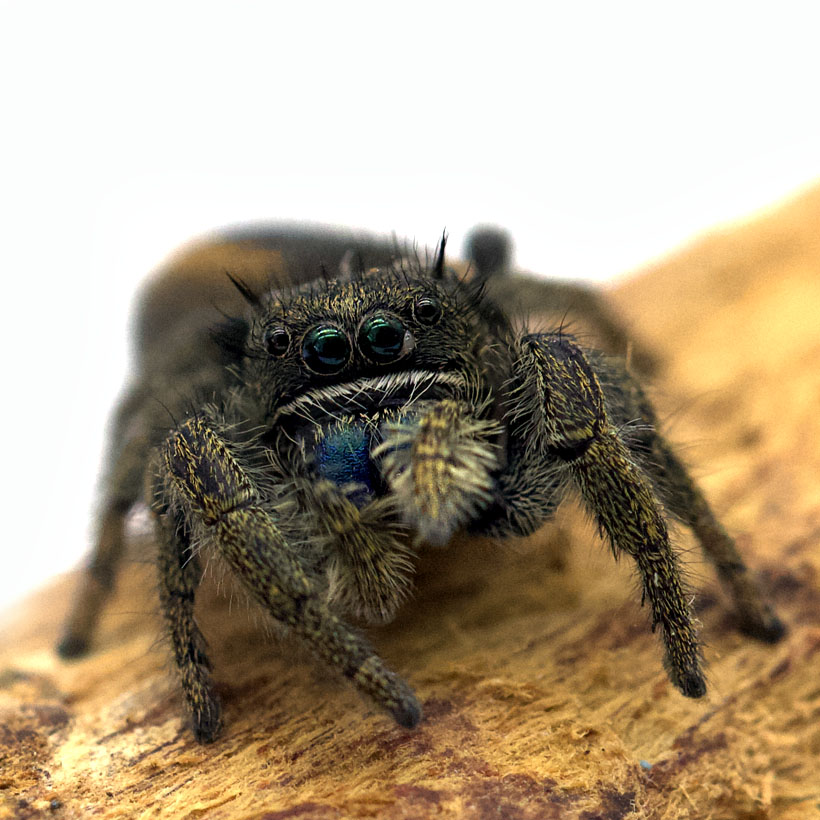
The visual dominance of jumping spiders is the foundation of this behavior. Their visual system is one of the most powerful among invertebrates. The large front eyes function like small telescopes. They provide a resolution that even many much larger animals cannot achieve.
Jumping spiders also have several smaller pairs of eyes that detect movements from all directions. As soon as something moves in their surroundings, they focus their main eyes on it. They only see color in the center of their field of vision – exactly where the dance is taking place.
The courtship dance is thus precisely tuned to the female’s perception. It utilizes her sensory strengths and circumvents her weaknesses. Evolution in concentrated form.
Habitats between forest and windowsill
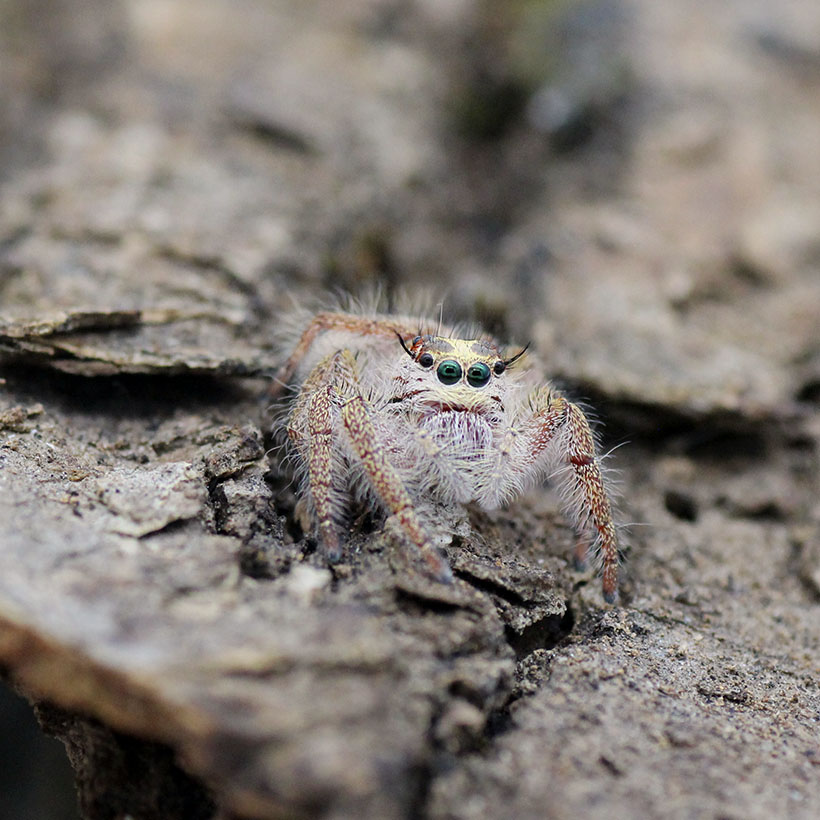
Jumping spiders are found almost worldwide. They can be found in forests, meadows, rocky landscapes and increasingly also in human settlements. Window frames, house walls and balconies replace natural structures such as tree bark or stones.
The dance remains the same. Whether in the tropical undergrowth or at the flower pot on the terrace – the sequence follows a fixed biological program. For nature observers, this opens up a rare opportunity: highly complex behavior can be observed directly in everyday life.
Misconceptions about spiders
Spiders are still considered primitive or purely instinct-driven. Jumping spiders clearly contradict this image. Their behavior shows planning, adaptation and situation-dependent decisions. The dance is innate. But its execution varies depending on the distance, the female’s reaction and the environment.
A common mistake is to regard dance as a “cute gimmick”. In fact, it is the result of massive selection pressure. Dance is precise, purposeful and biologically necessary.
Significance for observation and terraristics
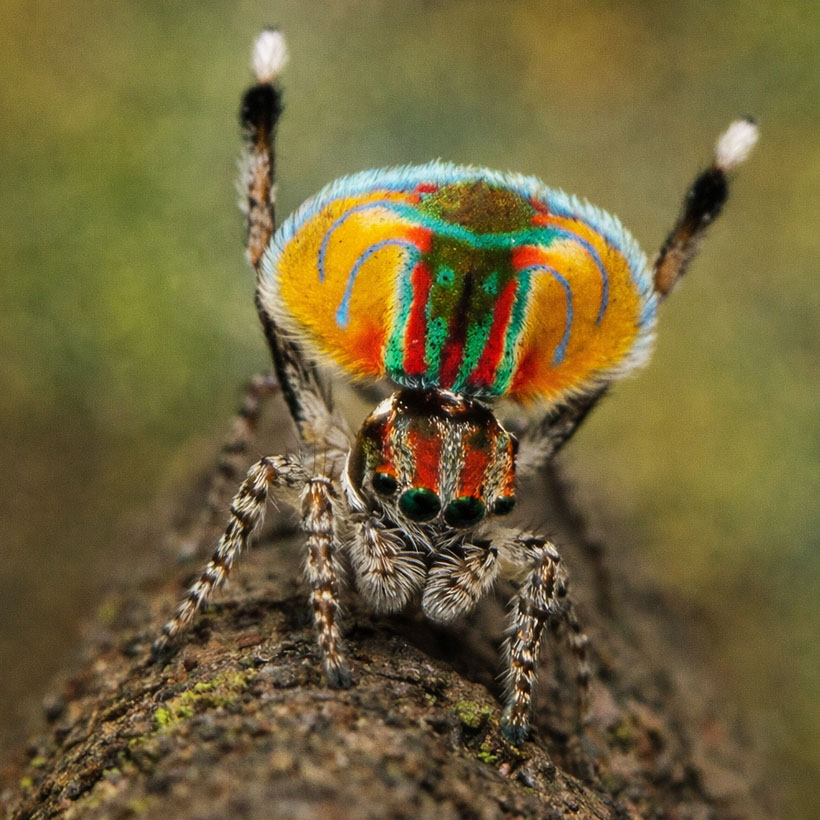
Jumping spiders also exhibit this behavior when kept. The prerequisites are structured surfaces, sufficient space and visual contact. Anyone keeping a jumping spider in a terrarium often experiences for the first time how active and alert these animals are.
The dance makes it clear that jumping spiders are not decorative pets. They react to light, movement and room structure. A near-natural design not only serves animal welfare, but also makes behavior visible and understandable.
A new look at the small things
Jumping spider courtship behavior is not a curious detail of nature. It is evidence of the extent to which evolution can shape behavior when perception, risk and reproduction come together. In an animal smaller than a fingernail, decisions that have been optimized over generations are condensed.
Those who observe jumping spiders do not see primitive reflexes. They see a system. Communication that is seen and felt. Signals that must be honest because deception does not work. A biological contract whose conditions are clear.
You don’t have to like them.
But once you have understood them, you will never see spiders as background noise again.
If you have any further questions, please leave them in the comments below the article.
Leave a Reply
You must be logged in to post a comment.